The Lava Lamp Afternoon
Imagine spending an afternoon making a lava lamp, accidentally covering her hair in vegetable oil, and accidentally teaching her about density. Here's how that afternoon might go
It started because Rosa asked why oil and water don't mix.
She'd seen me make salad dressing - shake the bottle, watch it swirl together, set it down, watch it separate again - and she'd asked about it at the time and I'd said "they just don't" which is the kind of answer that doesn't hold up to a seven-year-old for very long.
Two days later she brought it up again. "But why don't they mix?"
"Right," I said. "Let's find out."
Our mum, who was cooking dinner, raised an eyebrow. "No mess."
"Minimal mess," I said.
This was not entirely accurate.
The Setup
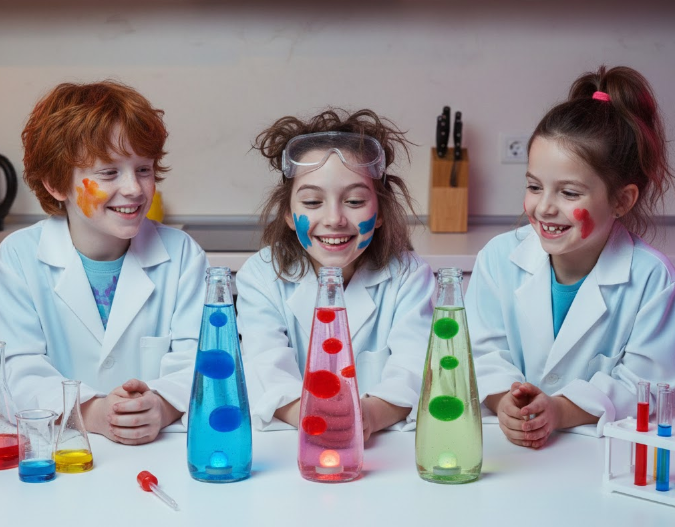
We needed a clear bottle, vegetable oil, water with food colouring in it, and Alka-Seltzer tablets. The idea was simple: oil floats on water because it's less dense. Drop in an Alka-Seltzer tablet and it reacts with the water to produce carbon dioxide bubbles. The bubbles carry blobs of coloured water upward through the oil, then pop at the surface and let the water sink back down. Lava lamp, from your kitchen cupboard.
I explained this to Rosa while we set up. She nodded impatiently, the way she nods when she's already thinking about the next thing.
We filled the bottle about a quarter full with oil. Then Rosa added the coloured water - she chose red, which immediately settled below the oil in a clean red layer. She looked at it with satisfaction.
"They're already not mixing," she said.
"They're already not mixing," I agreed.
"So what does the tablet do?"
I handed it to her. "Drop it in and find out."
What Happened
For a second, nothing. Rosa leaned in close, watching.
Then the tablet hit the water and fizzing started - small at first, then more urgent - and suddenly blobs of red water were rising through the oil in long wobbling streams, reaching the surface, popping, sinking back down. Rising again. The whole bottle was moving.
Rosa made a noise that wasn't quite a word and wasn't quite a question.
Then we knocked it over.
The bottle hit the table, the cap wasn't on properly, and a quantity of red-tinted vegetable oil went across the table and onto Rosa's sleeve and somehow, inexplicably, into her hair.
She looked at me.
"Minimal mess," she said.
We spent ten minutes cleaning up. Then we refilled the bottle and tried again, this time with the cap on and both of us standing at a safer distance.
The Questions
"Why do the bubbles bring the water up?" Rosa asked, watching the second attempt work perfectly.
"What do bubbles do normally?"
"They go up."
"Right. Because they're lighter than the liquid around them. So when a bubble forms on a bit of water, it carries that bit of water with it to the surface. Then the bubble pops and the water has nothing holding it up anymore."
She watched a blob of red rise, hover, sink. "So the water is hitchhiking."
"The water is hitchhiking," I said. "That's exactly it."
She wanted to know what would happen with more tablets. We tried it. More tablets meant more bubbles meant faster movement - the bottle looked almost frantic, everything rising and falling at once. She described this as "the water panicking."
"Does it ever stop?"
"When the tablet dissolves completely, yes. No more reaction, no more gas, no more bubbles."
She watched the bottle slow down, the movement becoming languid, then stopping. The red water settled back to the bottom. The oil floated, still and clear.
"It went back to the beginning," she said.
"It always does. They don't mix. They just visit each other for a bit."
Your Turn
You need a clear bottle or tall jar, vegetable oil, water with food colouring, and Alka-Seltzer tablets. Fill the bottle a quarter full with oil, add the coloured water, put the cap on, then drop a tablet in through the top and watch.
Try different colours. Try more tablets at once. Try a torch held behind the bottle in a dark room - the colours glow.
And if you knock it over: paper towels, patience, and try again. That's also science.