The Robot That Solves a Rubik's Cube Before You Can Blink
A Rubik's Cube, fully scrambled, solved in 0.103 seconds. Not by engineers at a major corporation, but by four undergraduates at Purdue University. Their robot solves the cube before you can blink. What does "solving" mean when the solver has no experience of the puzzle?
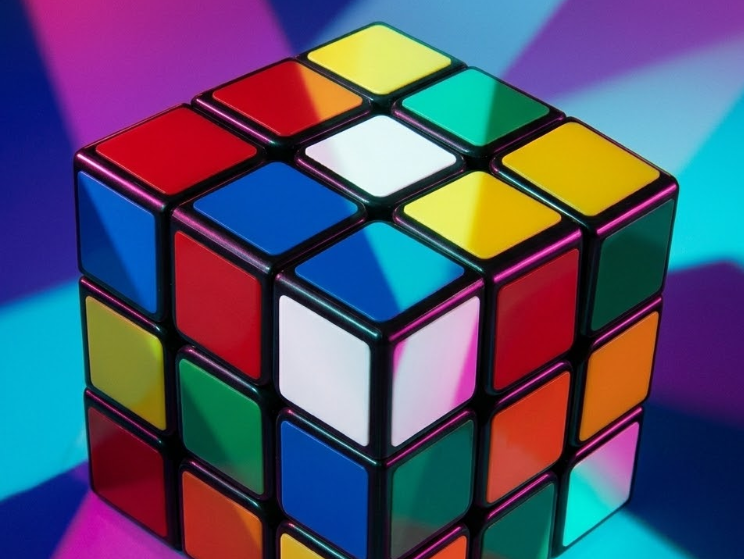
A Rubik's Cube, fully scrambled, solved in 0.103 seconds. Not by a professional speedcuber, not by a team of engineers at a major corporation, but by four undergraduate students at Purdue University in Indiana.
Their robot, called Purdubik's Cube, set a new Guinness World Record in April 2025 for the fastest robot to solve a puzzle cube. The previous record belonged to a machine built by Mitsubishi Electric engineers in Japan, which managed 0.305 seconds. Four students, working on a senior project, tripled that speed.
To put 0.103 seconds in context: a human blink takes roughly 200 to 300 milliseconds. The cube is solved before your eyes have finished closing.
How it works
The robot uses cameras and computer vision to read the colours on each face, then runs a custom-built algorithm to calculate the solution. Six motors twist the sides with industrial-grade precision, each move coordinated to the sub-millisecond. At those speeds, a standard Rubik's Cube would simply disintegrate, so the team had to build a reinforced cube strong enough to survive the forces involved.
There is also a neat piece of design: the cube is Bluetooth-enabled, so a user can scramble it remotely, and the robot mirrors each move before solving the whole thing the instant the scramble is complete.
The bigger picture
The best human speedcubers solve a Rubik's Cube in around three seconds. That is genuinely extraordinary. But a machine doing it thirty times faster raises a question worth sitting with: what does "solving" actually mean when the solver has no experience of the puzzle?
A human speedcuber recognises patterns, makes split-second decisions, manages adrenaline. The robot executes an algorithm. Both arrive at the same result. Whether they are doing the same thing is a question children tend to find more interesting than adults do.
Why it matters for kids
Matthew Patrohay, one of the four builders, first saw an MIT team solve a cube in 0.380 seconds when he was still in school. He decided then that he wanted to beat it. That was it. No grand mission statement, just a teenager watching a video and thinking: I could do better.
If your child has ever been obsessed with a Rubik's Cube, or with speed, or with the question of whether a machine can outdo a person, this is worth showing them. Not as inspiration to build robots, necessarily. As proof that the projects worth doing often start with a sentence that begins "I bet I could..."
The Rubik's Cube was invented in 1974 as a teaching tool for geometry. Fifty-one years later, it is still teaching, just not geometry any more.
Read more here: Purdue University, Elmore Family School of Electrical and Computer Engineering