The Country Building Robots Faster Than Anyone Expected
The robot stands 1.73 metres tall and weighs 75 kg. Its body has 29 degrees of freedom, with seven in each hand. The T800 is a good conversation starter about the difference between what a robot can do in a controlled demo and what it can reliably do in the real world.
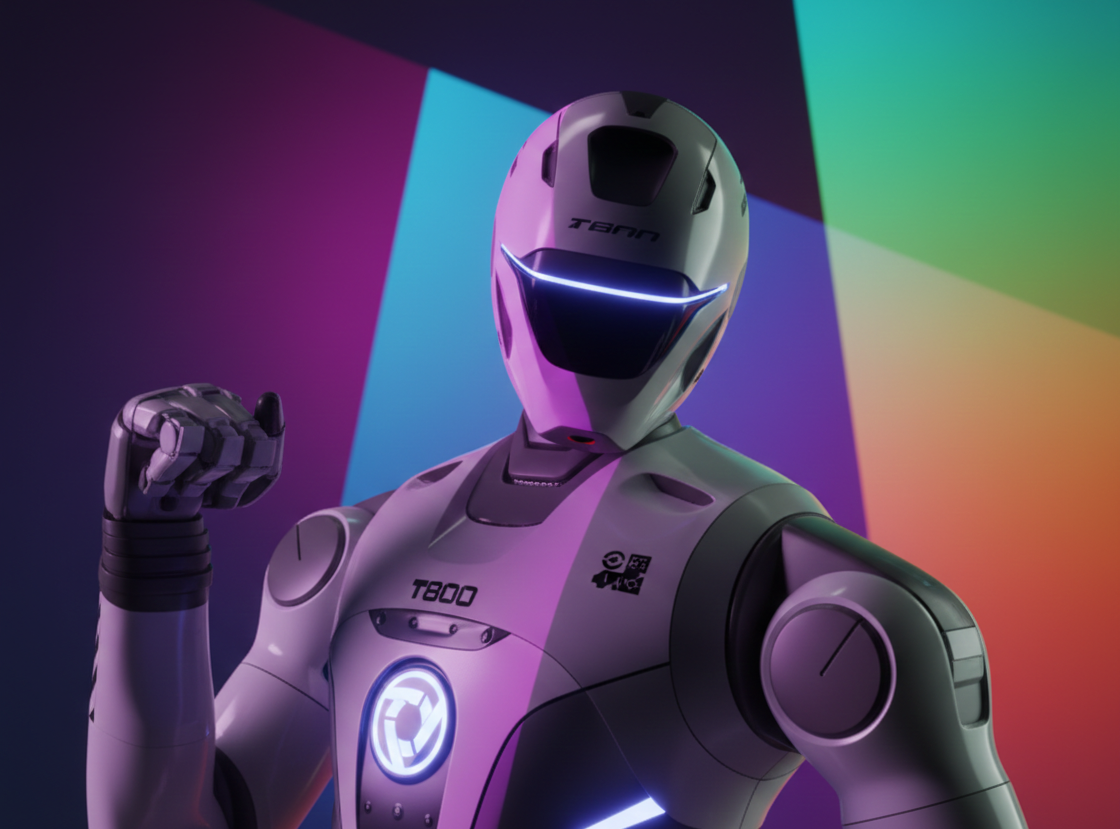
In December 2024, a Chinese robotics startup that had existed for less than two years released a video of a humanoid robot performing flying kicks. Within days, millions of people had watched it. Within weeks, many of them were convinced it was fake.
It wasn't. And that confusion tells you something important about where humanoid robotics has arrived.
The robot is the T800, made by EngineAI, based in Shenzhen. It stands 1.73 metres tall, weighs 75 kg, and has 29 degrees of freedom in its body, with seven more in each hand. When the launch video went viral, the movements looked too fluid, too precise, too cinematic to be real. EngineAI responded by releasing unedited footage, then their CEO posted a clip of the robot kicking him across the room. He got up. The robot stayed steady. Point made.
By January, the T800 was on the floor at CES 2026 in Las Vegas, its global debut, demonstrating full-body coordination to crowds of industry engineers. A few weeks before that, EngineAI had quietly placed units in retail stores in Shenzhen, not as demonstrations, but as working staff.
This is not one company's story
What makes the T800 worth paying attention to is not the robot itself. It is the pattern it sits inside.
EngineAI is two years old. It has already produced three previous humanoid platforms before the T800, raised the equivalent of £110 million in backing, and entered a market that includes Tesla, Boston Dynamics, and Figure AI. It is not alone. Xpeng, a Chinese electric car company, faced the same CGI accusations when it showed its Iron humanoid robot walking with a natural gait. UBTECH Robotics attracted widespread disbelief when it published footage of hundreds of its Walker S2 robots moving in coordinated formation through a warehouse. In each case, the accusation was the same: this cannot be real. In each case, it was.
The CGI scepticism is, in its way, a compliment. These robots are moving well enough that people assume they must be animated. That is a different problem from the one humanoid robotics had five years ago, when the challenge was simply making them walk without falling over.
Why this matters and how to discuss it with kids
The robots that appear in films and the robots being built in factories right now have always been separated by a large gap. That gap is closing faster than most people expected, and it is closing in places that might surprise children who assume the most advanced work happens in the United States.
A good question to put to a child: if a robot can kick down a door, does that mean it can fold a towel? The T800's industrial deployment focuses on repetitive assembly tasks, mounting components, moving objects, basic inspection.
The martial arts are real. The fine dexterity for household tasks is not there yet. Understanding why those two things can both be true at the same time is a genuinely interesting engineering problem.
It is also worth telling children that EngineAI's T800 had been redesigned three times in the year before launch, by a team of 150 engineers. The viral video was one minute long. The work behind it was not.
The robots are real. They are also early. Both things matter, and knowing the difference between a demo and a deployed product is one of the more useful things a young person can learn about technology right now.