Roads for Electricity
He pressed the battery down and the LED lit up. Red, steady, undeniable. "I made that happen," he said. "With tape." Then he built his mum a birthday card with a glowing window and copper tape roads hidden on the back. She asked if he'd made it. "I built a circuit. On paper. With roads.
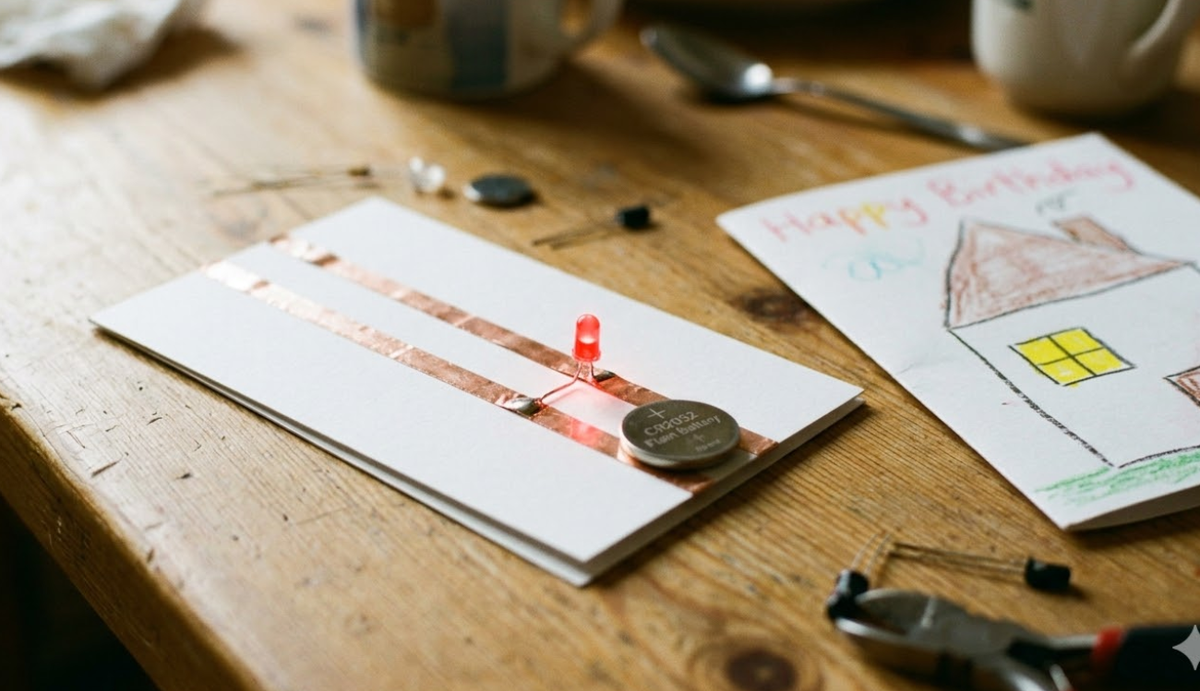
It started because Jude found a battery.
It was in the kitchen drawer, the one that's mostly rubber bands, takeaway menus, and a single AA that nobody can remember buying. He held it up like evidence.
"Does this still work?"
"Probably. Why?"
He didn't have a reason yet. He just liked that it was small and important-looking. He turned it over in his fingers, studying the plus and minus signs like someone deciphering a code.
"Can we make something light up?"
I looked at the battery. Then at the roll of copper tape I'd bought three months ago for a craft project that never happened. Then at the small bag of LEDs left over from Christmas, the tiny ones, like coloured grains of rice.
"Actually," I said, "yes. But we're going to do it on paper."
He looked at me like I'd said something fundamentally suspicious.
"Paper doesn't light up."
"The paper isn't lighting up. The paper is the thing everything else sits on. Like a road."
He considered this. Roads were acceptable.
The Setup
We started with a piece of white card, thick enough that it wouldn't flop about. I drew a small gap in the middle, about two centimetres wide, and told Jude this was where the light would go.
"We need to make a path for the electricity," I said. "From the battery to the light and back again."
I showed him the copper tape. Thin, flat, sticky on one side. He pulled off a strip and stuck it to the card in a wavering line from one side of the gap to the edge where the battery would sit.
"That's one road," I said. "Now we need another one going back. But the two roads can't touch."
"Why not?"
"Because electricity is lazy. If the two roads touch, it'll just go straight across without bothering to visit the light. It'll take the shortcut."
He found this deeply relatable. He laid the second strip carefully, parallel to the first, leaving a clear gap between them the whole way.
"Now the light."
I handed him one of the LEDs. Two thin metal legs sticking out the bottom, one slightly longer than the other.
"The long leg goes on one road. The short leg goes on the other. It matters which way round."
He placed it across the gap, one leg on each strip, and pressed them down with more tape to hold them flat.
"Now what?"
"Now we connect the battery."
The Science Bit (Which Happened Naturally, I Promise)
He pressed the coin battery across the two strips of tape at the other end of the card. One side touching one strip. The other side touching the other.
The LED lit up. Red, steady, undeniable.
Jude didn't say anything for about three seconds. Then: "I made that happen."
"You did."
"With tape."
"With tape."
He stared at it. A tiny red light glowing on a piece of white card on the kitchen table, connected to a battery by two wobbly lines of copper tape. It looked like something between a greeting card and a very basic spaceship control panel.
"How is the tape making it work, though? It's just tape."
"What do you think copper is?"
He shrugged. "Metal?"
"Right. And what do metals do that paper doesn't?"
He thought about it. "They're shiny?"
"They're also really good at letting electricity through. That's what a conductor is. Something electricity can travel along. Copper is one of the best. So when you stick copper tape to paper, you've basically built a tiny road that electricity can follow."
"And the light is like a... toll booth?"
I hadn't expected that one. "That's actually brilliant. Yes. The electricity has to pass through the LED to get from one road to the other. And when it does, the LED uses a tiny bit of that energy to make light."
He peeled the battery off. The light went out. Pressed it back on. The light came back.
"I'm controlling it," he said, with the quiet satisfaction of someone who has just discovered power.
The Testing Phase
He wanted to know: could he add a second light? We tried. It worked, but both LEDs were dimmer. The battery was sharing its energy between them, and Jude said they looked "tired." What happened if he put the LED legs on the wrong way round? Nothing. No light. He flipped it and it came back. He found this unreasonable but accepted it.
Then he asked: what if we break the road?
He peeled up a section of copper tape in the middle. The light went out.
"The electricity can't get across," he said.
"That's called an open circuit. You've broken the path."
He pressed it back down. The light returned.
"And that's a closed circuit. Complete road, electricity flows, light comes on."
He tore a small square of paper and placed it over the gap, then pressed the tape back down on top.
"Paper isn't a conductor, right?"
The light stayed off.
He spent the next twenty minutes drawing a card for his mum. A house at night with a yellow LED glowing in the window. The copper tape roads were hidden on the back, the battery taped flat. He drew a small arrow that said PRESS HERE and folded a flap of card so pressing it pushed the battery against the tape and completed the circuit.
His mum opened it that evening. The window lit up. She looked at the back with its mess of copper strips.
"Did you make this?"
"I built a circuit," he said. "On paper. With roads."
The Next Day
He told his teacher about it on Monday. Apparently he described an LED as "a tiny light that only works one direction, like a one-way street." His teacher sent a note home asking if we had spare copper tape, because now the whole class wanted to try it.
The house card stayed on the mantelpiece. The one-way street explanation stuck.
Your Turn
You need four things: a piece of card, copper tape (a few quid online, look for the kind with conductive adhesive), a coin cell battery (CR2032, the flat round ones), and an LED or two with wire legs.
Lay two strips of copper tape on the card, leaving a gap for the LED. Place it across the gap, long leg on one strip, short leg on the other. Press the battery across both strips at the far end. If nothing lights, flip the battery or check the LED is the right way round.
Then start breaking things. Peel up a section of tape. Try putting different materials in the gap: foil, paper, a coin, a rubber band. Find out what lets the electricity through and what stops it. That's the real experiment. Not the circuit that works, but figuring out why some things block it.
And if a seven-year-old asks whether he can make his birthday cards light up from now on, just buy more copper tape. You're going to need it.