What Happens When You Give a Kid Some Foil and a Reason to Fail
Two challenges where the testing is better than the building. All you need is foil, straws, and tape. Total cost: almost nothing. Total mess: moderate.
These two challenges have something in common: the testing is better than the building. You make a thing, you load it up, and you find out exactly how much it can take before it fails. There's something deeply satisfying about this for kids. And if I'm honest, for adults too.
Both use supplies that cost almost nothing and are probably already in a kitchen drawer somewhere.
Aluminium Foil Boat Challenge
The first boat sinks immediately. This is normal and important. The second boat will be wider, flatter, and hold maybe three coins. By the third attempt they're thinking about hull shape and weight distribution without knowing those words.
What you need: Aluminium foil, a basin of water, coins or small weights
The challenge: Make a boat that can hold the most coins before sinking.
Your job: provide the coins and count how many it holds. Make approving noises. Resist the urge to show them how to make a better one.
Total cost: nothing. Total mess: moderate. Total screen time avoided: at least 20 minutes, often more because they'll want to beat their own record.
Straw and Tape Structures
Triangles are strong. Squares collapse. They'll learn this the hard way, which is the only way that sticks. The testing is the best bit. Piling books on a tiny straw structure until it gives way has the same energy as a slow-motion demolition video.
What you need: Drinking straws, tape
The challenge: Build the strongest structure possible. Test by stacking books on top.
Your job: supply the books for testing. Maybe put down newspaper if you're using the dining table.
Both of these work from about age 5, though the straw structures tend to hold attention longer with 7-year-olds and up. For older kids, add competition: most coins held, most books supported, lightest structure that can still hold a dictionary.
Keep foil, straws, and tape in a drawer together. That's three challenges' worth of supplies (including the marble run from part 1) for under £2. Not bad for an emergency boredom kit.
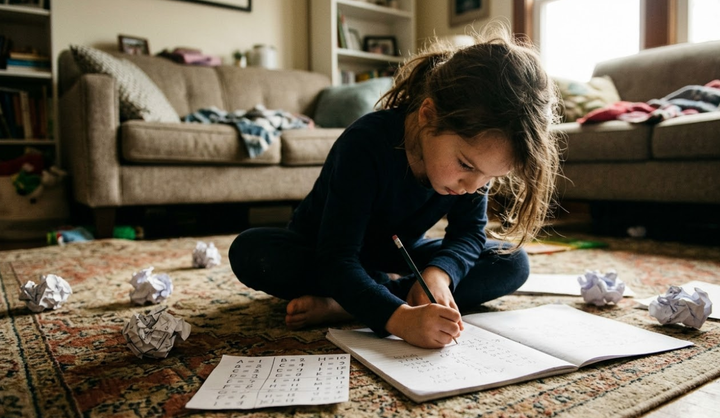
The boat sank on the first coin. She stared at it for a second, said "that's rubbish," tore off a new sheet of foil, and started again. I didn't say a word. Didn't need to.
This is part 4 of the 20 Minutes of Peace series. 100 STEM challenges that use what's already in your house and don't need you standing over them.