Should You Sign Them Up for a Robotics Club?
The most valuable thing about a robotics club isn't robotics. It's being in a room with other children who are interested in how things work. For some children, that room is the first place they've felt like their kind of thinking is normal.
The kit arrived on a Wednesday. Forty-three pieces, a USB cable, and a booklet that used the word “actuator” on page two.
Your child opened it like it was Christmas. You opened the booklet, read half a page, and quietly put it back in the box.
That was three weeks ago. The kit is still on the kitchen table, mostly built, not quite working. And now your child’s teacher has sent home a leaflet about a robotics club that runs on Saturday mornings, and you’re looking at it the way you look at things you suspect will become your problem.
Term fees. Equipment lists. A website with the word “computational” in the first paragraph. A photo of children in matching t-shirts holding a trophy. You’re trying to work out whether this is something your child needs or something you’ll pay for and drive to for six weeks before they lose interest.
Both are possible. Here’s what’s worth knowing before you decide.
What actually happens at a robotics club
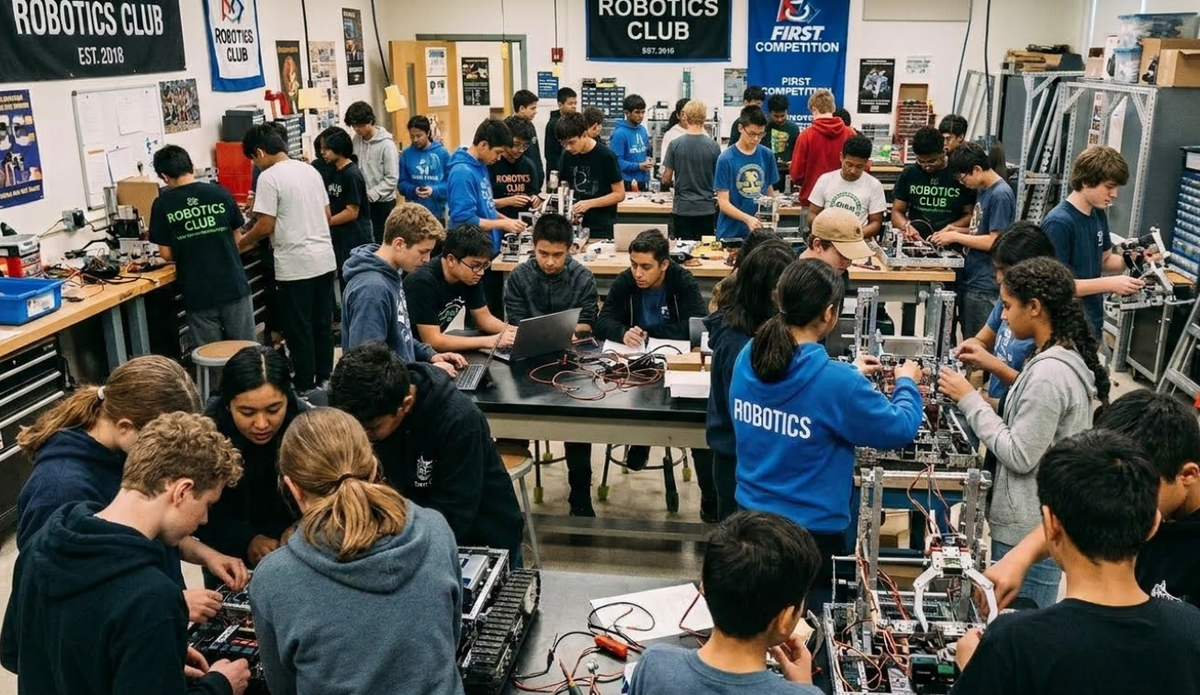
This varies enormously, and that’s the first thing worth understanding. Some clubs are essentially structured classes: a tutor, a curriculum, a kit everyone uses, a build everyone follows. Others are closer to open workshops where children work on whatever they like with varying levels of supervision. Competition-focused clubs train toward specific events and can be intense. Drop-in sessions at libraries or community centres tend to be looser, more exploratory, and significantly cheaper.
None of these is automatically better than the others. What matters is whether it’s the right shape for your child. A child who likes being told what to build will flounder in an open workshop. A child who wants to invent things will be bored rigid following someone else’s instructions for eight weeks. If you can, go and watch a session before you commit. Most decent clubs will let you.
The cost question
It’s worth being honest about this because nobody else seems to be. Term-based robotics clubs typically run between £40 and £120 for a six-to-eight-week block, depending on where you live and whether kits are included or purchased separately. Competition teams can cost more: travel, registration fees, and the kits themselves, which range from £30 for a basic set to well over £200 for something like LEGO Mindstorms or VEX.
Library-run and council-funded sessions are often free or near-free, and they’re worth checking before you look at anything else. Ask at the desk. A surprising amount of this goes unadvertised. It’s on a photocopied flyer by the returns shelf, not on the website.
If cost is a factor, and it is for most people regardless of whether they say so, start with the free options. Your child will learn whether they actually enjoy it before you’ve spent anything.
How to tell if it’s any good
Watch the children, not the tutor. In a good session, the children are talking to each other, trying things, arguing about what went wrong. In a less good one, they’re waiting. Waiting for instructions, waiting for help, waiting for someone to tell them what to do next. Robotics is fundamentally about solving problems you don’t yet have the answer to, and if the club has removed all the problems in advance, it’s not teaching very much.
Ask the person running it what happens when something breaks or doesn’t work. If they say “we troubleshoot together,” that’s a good sign. If they say “we follow the instructions carefully so that doesn’t happen,” that’s a less good sign.
The commitment question
Most clubs ask for a term at a time. That’s reasonable. What’s less reasonable is the guilt some parents feel about stopping after one term, as though pulling out means giving up on their child’s future in engineering.
One term is enough to know. If your child comes out buzzing, talking about what they built, wanting to show you, that’s clear. If they come out quiet, indifferent, reaching for their coat before you’ve parked, also clear. Children are not subtle about this. Trust what you see.
Some children do robotics for a term, enjoy it, move on, and never come back to it. That is a perfectly fine outcome. They tried something. They learned that this particular thing isn’t their thing, or that it is their thing but not right now. Both are useful information.
The bit nobody tells you
The most valuable thing about a robotics club isn’t robotics. It’s being in a room with other children who are interested in how things work. For some children, particularly the ones who are a bit quiet at school, a bit more comfortable with objects than with social dynamics, that room is the first place they’ve felt like their kind of thinking is normal.
You can’t engineer that. You can’t guarantee it. But it’s worth knowing it sometimes happens, because it won’t be on the flyer.
So. Should you sign them up? If your child mentioned it, even casually, even once, it’s probably worth a try. Find the cheapest, most local option. Go once. See what happens.
And if it turns out to be a phase, a six-week enthusiasm that peaks and fades like every other enthusiasm they’ve had since they were four, that’s fine. They were in a room where things were being built, and they were part of it for a while. That’s not nothing.