Secret Code Breaker
Make your first message something good. Not 'hello how are you.' A secret. A compliment. The location of a hidden treat. The message matters because it's the reason they'll want to write one back.
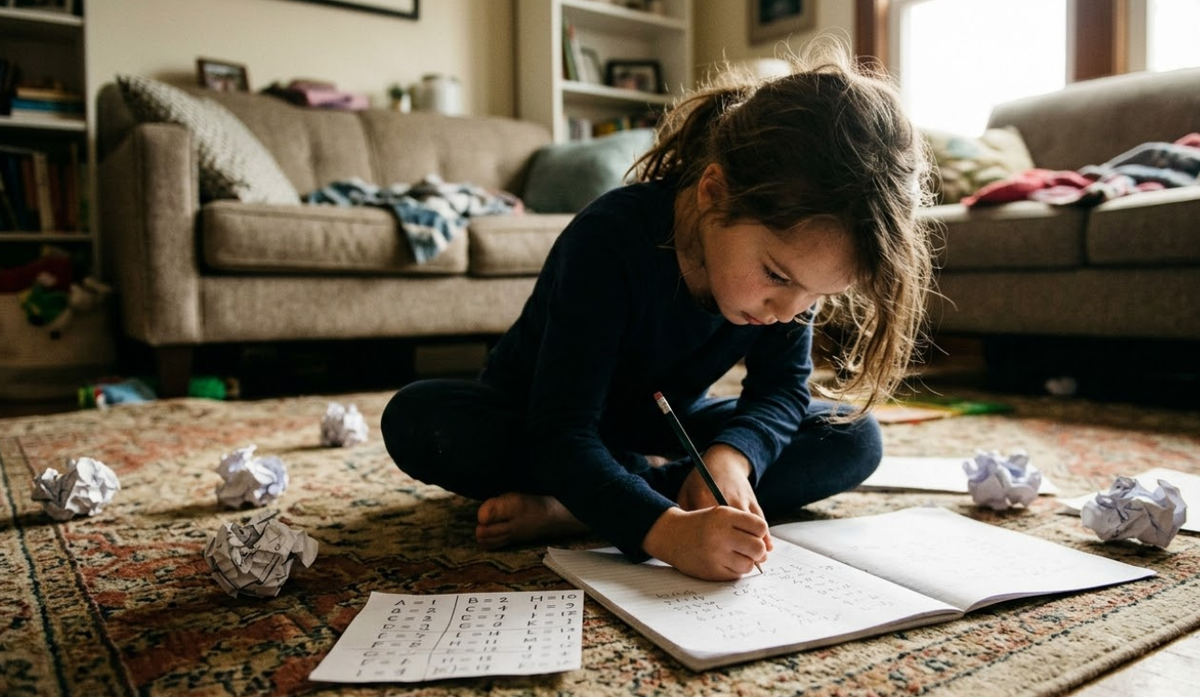
They’re bored. You can tell because they’ve started narrating their own boredom. “There’s nothing to do.” They said it to the ceiling. They’re lying on the floor. It’s been eleven minutes since lunch.
This is the one you pull out of your pocket for moments like that. No supplies to gather. No prep. Just a pencil, a piece of paper, and about thirty seconds of your time to write a message they can’t read. Yet.
What it actually looks like
You write them a note in number code. A=1, B=2, all the way to Z=26. Something like: 20-8-5-18-5 9-19 3-8-15-3-15-12-1-20-5 9-14 13-25 19-15-3-11 4-18-1-23-5-18. Hand it over. Walk away.
What happens next is genuinely quiet. They sit there, working through each number, writing letters above them, frowning, mouthing words. You’ll hear “wait, that can’t be right” at least once. Then the grin when the message clicks into place.
Then they write one back for you. And this is where the real time gets eaten, because composing a coded message is harder than cracking one. They have to think about what to say, then convert every single letter. It’s spelling and maths and patience all at once, and they don’t notice any of it because they’re too busy trying to be sneaky.
What you need
Supplies: Paper. Pencil. That’s it.
Prep time: About 30 seconds to write your coded message. Possibly another minute if you have to count on your fingers for the letter Q. No judgement.
Ages: Works from about 6 up, once they can reliably connect letters to the alphabet in order. Five-year-olds can do it if you write the key out for them (A=1, B=2 etc.), but expect to be called over a lot. Seven and up, they’re away.
Time it buys you: 20 minutes for decoding your message and writing one back. Longer if they get competitive about it and start writing coded messages to everyone in the house, which they will.
What actually happens
Fair warning. They will get letters wrong. The number 20 will become T in one word and U in the next, because counting to 20 in the alphabet is surprisingly easy to mess up when you’re excited. They’ll decode “THFRE IS CHOCOLAUE IN MY SOCK DRAWER” and either figure out their mistake or ask you why you can’t spell. Either outcome is fine.
Some kids will want you to write out the full alphabet key. Let them have it. This isn’t a memory test. The point is the decoding, not the suffering.
Also: make your first message something good. Not “hello how are you.” A secret. A compliment. The location of a hidden treat. The message matters because it’s the reason they’ll want to write one back. “Your brother’s birthday present is hidden in the garage” will fuel a solid half hour of frantic decoding. “Have a nice day” will not.
If you want to stretch it
Once they’ve cracked the basic number code, shift it. A=2, B=3. Now every letter is one off from what they expect, and they have to build a new key and start over. This is, technically, a Caesar cipher. You don’t need to tell them that. Or do, if they’re the kind of kid who likes knowing the proper name for things.
You can also go the other way. Let them invent their own code. Symbols, shapes, whatever they want. They write the key, they write the message, they hand it to you, and you have to crack it. This reversal is where the real thinking happens, because designing a code that’s hard but possible takes more logic than solving one.
The funny thing about this one is how seriously they take it. The message could be completely mundane. “I like pizza.” Doesn’t matter. The fact that it was hidden makes it important. Secrecy turns everything into treasure.
That’s not a bad thing to let them feel.