The Skill That Doesn’t Look Like Maths
The skill that best predicted their arithmetic performance three years later wasn't intelligence or early number ability. It was something most maths lessons never mention.
Why spatial reasoning might be the foundation your child’s maths curriculum quietly assumes is already there.
Researchers at the University of Potsdam followed 1,851 children from the age of five through to eight. They measured the usual things: intelligence, working memory, early number skills. But they also measured something most studies skip - how well these children could perceive spatial relationships. Not rotate shapes in their heads. Not solve puzzles under time pressure. Just: look at this arrangement of objects and understand where things are in relation to each other.
That basic spatial perception, measured at age five, was still predicting children’s arithmetic performance three years later - even after the researchers accounted for intelligence, executive function, and prior maths ability.
The finding that kept predicting, even when it shouldn’t have mattered.
The thinking your child does before they know they’re thinking
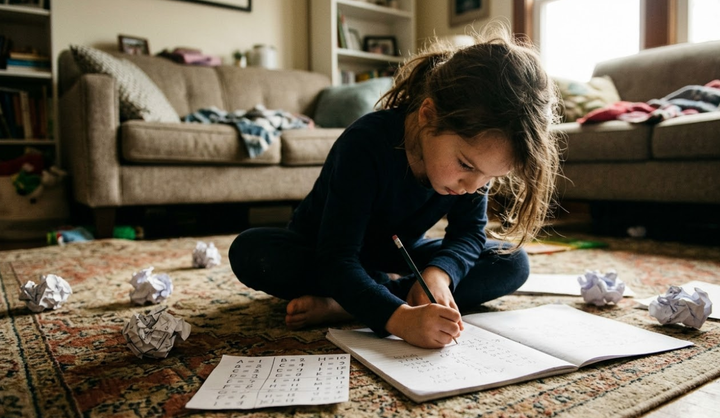
Spatial reasoning sounds clinical. In practice, it’s the thinking your child does when they’re working out whether a toy fits in the box, or predicting which Tetris piece goes where, or figuring out why the tower they built keeps falling to the left. It’s what happens when they look at a jigsaw puzzle and know - before trying - that this piece belongs over there.
It doesn’t feel like maths. It doesn’t look like maths. But a growing body of research suggests it is one of the most reliable cognitive foundations for mathematical development and one the curriculum rarely teaches directly.
The Potsdam study, published in Learning and Instruction in 2026, distinguished between two types of spatial skill. Visual-spatial perception is the ability to see and understand spatial relationships as they are with no mental manipulation required. Visual-spatial short-term memory is the ability to hold spatial information briefly in mind, like remembering where objects were on a tray. Both mattered for early maths. But perception had the longer reach. It was the only spatial subskill that directly predicted arithmetic at age eight, even when everything else was controlled for.
What a number line has to do with a toy box
The connection between space and number is not a metaphor. It runs deep in how the brain represents quantity. When a child understands that 7 is more than 3, part of what they’re doing is placing those numbers in a spatial relationship - 7 is further along, further right, further up. The internal number line that most adults take for granted is, at its root, a spatial structure.
Children who can perceive and hold spatial relationships find it significantly easier to understand what the hundreds column actually means visually — before it becomes an abstract symbol. Place value, number comparison, mental arithmetic: these all draw on the ability to organise information spatially. When a child is asked to subtract 38 from 72, part of the difficulty is keeping two quantities in mind and understanding the spatial relationship between them. For a child with strong spatial foundations, this is manageable. For a child without them, it’s like being asked to read a map they’ve never been taught to hold.
A meta-analysis of 73 studies confirmed the connection: spatial skills are significantly and positively correlated with mathematical ability across ages. And a separate meta-analysis of 29 intervention studies found that training spatial skills produced improvements in maths with an effect size of 0.28, which, to put it in context, compares favourably to the average effect of dedicated maths interventions themselves.
The good news that requires a caveat
Spatial skills respond to practice. This is now well-established. A randomised study involving 17,648 children aged six to eight, published in Nature Human Behaviour, found that seven weeks of spatial cognitive training alongside maths instruction significantly improved mathematical learning. The most effective spatial tasks were those involving visuospatial working memory and reasoning — not just spatial manipulation like rotating shapes.
And the training doesn’t need to be digital or formal. A 2023 randomised controlled trial of 182 eight-year-olds found that children who practised spatial skills using physical materials — foam shapes they could pick up, turn, and fit together — showed larger and more consistent gains in maths than children who did the same activities on screen without manipulatives. Four sessions of 30 minutes, spread across two weeks.
The caveat: the Potsdam study also found bidirectional relationships between spatial and mathematical skills during the preschool years. This means early maths learning itself appears to strengthen spatial perception, not just the other way around. The relationship is a loop, not a one-way street. Interventions that treat spatial training as a silver bullet for maths miss this. Building spatial foundations matters, but it works best alongside, not instead of, good mathematical instruction.
What this doesn’t mean
This isn’t a story about finding a maths shortcut or an activity that boosts test scores. The research is about foundations - the underlying mental machinery that makes mathematical ideas easier to grasp when they arrive.
A child who has spent years doing puzzles and building things doesn’t necessarily know more maths. They find it less mysterious. The numbers still need to be taught. The operations still need to be practised. But when the curriculum introduces fractions, or asks them to visualise what happens when you divide a shape in half, or expects them to understand a bar chart — the child with strong spatial foundations has a frame to hang it on. The child without one is trying to learn content and build the frame at the same time.
It is also worth noting that spatial skill is one foundational element among many. Working memory, language ability, executive function, the quality of teaching, all of these matter. The spatial research doesn’t diminish them. It adds something most parents (and most curricula) have not thought about.
Why five matters more than you’d think
The Potsdam findings are particularly pointed about timing. Spatial perception measured at age five predicted mathematical skills at age six, which in turn predicted arithmetic at age eight. The pathway was cumulative: early spatial skills didn’t bypass intermediate maths learning; they fed it, and that learning fed what came next.
This is consistent with a meta-analysis of 20 spatial training studies involving children aged zero to eight, which found a large overall effect size (0.96) for spatial training relative to control conditions. Younger children responded well. The research suggests that spatial skills are most malleable during the early years, and the returns on building them are greatest when children are forming their initial understanding of number.
None of this means it’s too late at seven or nine. The 17,648-child study worked with six- to eight-year-olds. The physical manipulatives trial worked with eight-year-olds. But the longitudinal evidence is clear: the earlier spatial foundations are in place, the more mathematical learning they support.
Where to start this week
The best spatial activities for young children are the ones that don’t require a purchase or a plan. Jigsaw puzzles, building with blocks or LEGO, tangrams, games that involve fitting shapes together or navigating space. Origami. Drawing from observation rather than imagination. Cooking, where a child has to estimate whether the mixture will fit in the bowl. Packing a bag for a trip and working out what goes where.
The research on physical manipulatives is worth taking seriously here. The children in the 2023 trial who used foam cut-outs outperformed those who trained digitally. There is something about handling a shape, rotating it in your hands, checking whether it fits — that appears to strengthen the spatial processing in a way that screen-based equivalents do not match. This doesn’t mean apps are useless. It means the box of blocks in the corner is probably doing more than you think.
None of these feel like maths practice. That’s rather the point.
Research Sources
Poltz, N., Ehlert, A., Quandte, S., Kucian, K., von Aster, M., & Esser, G. (2026). Visual-spatial skills and children’s math development. Learning and Instruction, 101, 102246. 1,851 German children, longitudinal from age 5 to 8. doi.org/10.1016/j.learninstruc.2025.102246
Judd, N., & Klingberg, T. (2021). Training spatial cognition enhances mathematical learning in a randomized study of 17,000 children. Nature Human Behaviour, 5, 1548–1554. Randomised, 17,648 children aged 6–8, 7 weeks. doi.org/10.1038/s41562-021-01118-4
Gilligan-Lee, K. A., et al. (2023). Hands-On: Investigating the role of physical manipulatives in spatial training. Child Development, 94(5). Randomised controlled trial, 182 children, mean age 8. doi.org/10.1111/cdev.13963
Hawes, Z., Moss, J., Caswell, B., Seo, J., & Ansari, D. (2019). Spatial thinking as the missing piece in mathematics curricula. npj Science of Learning, 4(1). Meta-analysis of 29 studies (N = 3,765). doi.org/10.1038/s41539-019-0055-6
Xie, F., Zhang, L., Chen, X., & Xin, Z. (2020). Is spatial ability related to mathematical ability: a meta-analysis. Educational Psychology Review, 32, 113–155. Meta-analysis of 73 studies. doi.org/10.1007/s10648-019-09496-y
Lauer, J. E., & Lourenco, S. F. (2016). Spatial processing in infancy predicts both spatial and mathematical aptitude in childhood. Psychological Science, 27(10), 1291–1298.
Jia, X., Liang, Y., Lu, Y., & Wan, P. (2020). Is early spatial skills training effective? A meta-analysis. Frontiers in Psychology, 11, 1938. Meta-analysis of 20 studies, children aged 0–8. doi.org/10.3389/fpsyg.2020.01938