Five minutes. That's all it takes for a motivated kid to give up on robotics.
Motivated kids don't quit because they can't do it. They quit because they were stuck for five minutes with no one nearby. That's the whole difference between a child who loves robotics and one who says they hate it.

Not five weeks of struggle. Not a bad teacher or the wrong kit. Five minutes stuck alone with a problem they can't solve, and most seven-year-olds shut down completely.
That's the finding that stood out in a 2024 study tracking 120 second-graders learning robotics — and it reframes almost everything parents worry about when their child says they hate it, can't do it, or wants to quit.
The study wasn't looking for this
Researchers followed four classes of 30 children aged 7–8 working with Thymio robots. The goal was to map what children this age can actually do — how far they can get independently, where they hit walls, and why.
They built a six-level framework to measure capability. Most seven-year-olds landed at Level 3–4: capable of sequences ("go forward, then turn"), not yet capable of conditional logic ("if the robot sees red, turn left — otherwise keep going"). That gap is developmentally normal and expected.
What wasn't expected was how fast engagement collapsed without support.
The five-minute window
Children in the study stayed highly motivated throughout — they loved the robots, they wanted them to work, they kept trying. But when they hit a problem they couldn't solve, something specific happened.
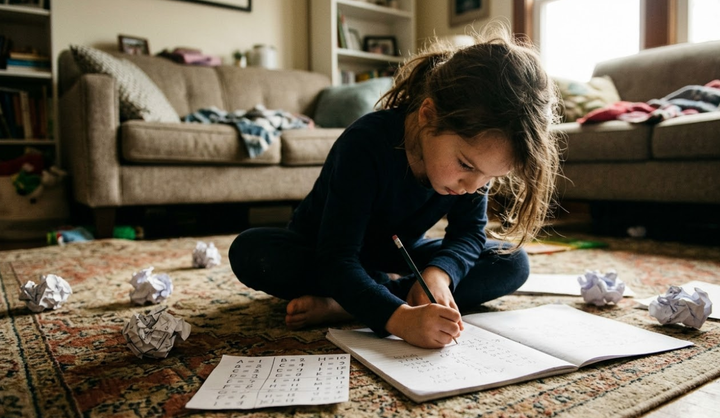
The children with an adult nearby got unstuck quickly and kept going. The children without one didn't ask for help. They repeated the same approach that already failed, got progressively more frustrated, and within about five minutes, stopped trying altogether.
Not because they'd decided they couldn't do it. Because they'd been stuck long enough that continuing felt worse than stopping.
Why they didn't ask
This is the part worth sitting with. These were motivated children who genuinely wanted to succeed. They weren't giving up easily — they were trying hard, repeatedly, on something that wasn't working.
They just weren't asking for help. Because asking for help requires knowing you need it, knowing who to ask, and being willing to admit you're stuck — a combination that's harder for a seven-year-old than it sounds, especially when they're frustrated.
The implication is uncomfortable: high engagement looks like success from the outside. A child trying repeatedly isn't a child learning. Sometimes it's a child five minutes from shutting down.
What this means practically
The children who did best in the study weren't the most capable. They were the ones with an adult close enough to notice when they'd been stuck too long.
Not directing them. Not solving it for them. Just available — able to ask the right question, point at the right thing, or simply confirm that the problem was real and solvable — before the five minutes ran out.
At home, that looks like staying in the room. At school, it's class sizes small enough that a teacher notices. The support doesn't need to be intensive. It needs to be fast.
Seven-year-olds can absolutely learn robotics. The research is clear on that. But the difference between a child who does and a child who decides they can't isn't talent or interest.
It's whether someone was there within five minutes.
Study: "Teaching Robotics Concepts to Elementary School Children" (2024). Available at: https://www.academia.edu/74193380/