Robotics for 13+ Year Olds: When the Kit Stops Being the Point
Most 13-year-olds don't want to follow a tutorial. They want to build the thing they saw on YouTube at midnight. The tools available to them now are the same ones adults use. The right kit at this age isn't the most advanced one. It's the one they'll finish.
Thirteen-year-olds don't want to follow a tutorial. They want to build the thing they saw on YouTube at midnight, and they want it to work by Thursday. The gap between what they can imagine and what they can execute has never been wider, and for the first time, the tools available to close that gap are the same ones adults use.
What changes at thirteen
The cognitive shift is subtle but consequential. A twelve-year-old can debug code. A thirteen-year-old can architect a project: break it into subsystems, decide which to build first, and anticipate where the problems will be. They don't always do this well, but the capacity is there, and the kits that work at this age are the ones that reward planning rather than just execution.
Abstract thinking is now genuinely available. A thirteen-year-old can understand that a PID controller is a mathematical concept, not just a setting to adjust until the robot drives straight. They can read a datasheet for a sensor and extract the information they need without someone translating it for them. They can learn from a Stack Overflow answer written for adults.
Motor skills are adult-level. Soldering is now a realistic expectation for most, not a stretch goal. They can handle small screws, crimped connectors, and wiring that requires patience rather than dexterity.
What they still lack is project management. A thirteen-year-old will spend four hours on a cosmetic detail while the core functionality remains broken. They will redesign the chassis three times before writing a line of code. They will start a second project before finishing the first. The parental role at this age is less about technical help and more about structure: "What's the minimum version that works? Build that first."
The kits
ELEGOO Smart Robot Car Kit V4.0 (if they haven't used it)
This appeared in the 11-12 guide, and for a thirteen-year-old new to robotics, it remains a strong entry point. The difference is pace. Where an eleven-year-old might spend weeks exploring each mode, a thirteen-year-old will typically have it built, running, and modified within a weekend. They'll be rewriting the obstacle avoidance logic by day three.
At around £60-70, the financial risk is low, the Arduino ecosystem is vast, and the car itself becomes a platform for whatever they want to bolt onto it: a camera module, additional sensors, a custom chassis printed on a 3D printer if they have access to one. The kit is the starting line, not the finish.
The honest downside remains the initial setup. The Arduino IDE and driver installation can produce errors that have nothing to do with robotics and everything to do with operating system quirks. Budget half an hour for this before anyone touches a motor.
For the thirteen-year-old who has never seen a breadboard, this is where to start. For one who has already used Arduino at eleven or twelve, skip ahead.
Petoi Bittle X (the one that walks)
Bittle X is a quadruped robot dog with nine servo joints, and it is the first kit on this list that provokes a genuine emotional response. When it walks, stumbles, and rights itself, even adults stop and watch. For a teenager, that reaction from other people, showing the thing they built to friends and family who are visibly impressed, is a motivator that no line-following car can match.
The construction kit version takes three to four hours to assemble, including calibrating each servo joint to get the gait right. That calibration process is fiddly and occasionally maddening, involving tiny adjustments with a tuning tool until all four legs move in sync. It teaches patience in a way that no amount of parental encouragement can replicate, because the reward (a robot that walks smoothly) is immediately visible when you get it right.
Programming starts with Petoi's block-based Coding Blocks interface, which most thirteen-year-olds will use for about twenty minutes before switching to the Arduino IDE or Python. The open-source OpenCat framework means the community has already built behaviours ranging from dance routines to obstacle avoidance using a camera add-on. A teenager with some Python experience can have Bittle responding to voice commands within a week.
At roughly £300 for the construction kit (around £340-400 for the pre-assembled Bittle X with alloy servos), this is a significant purchase. Battery life is approximately one hour of continuous walking, which is enough for a session but not a whole afternoon. The servos, while improved in the V2, can strip if the robot repeatedly falls from a height, and replacements cost roughly £5-8 each. If your child treats hardware roughly, factor that in.
Not for a beginner. The assembly assumes comfort with small components, and the programming assumes either prior Arduino experience or the willingness to learn it. Very much for the teenager who wants a robot that feels alive and has the patience to make it so.
Arduino Starter Kit (the one that isn't a robot)
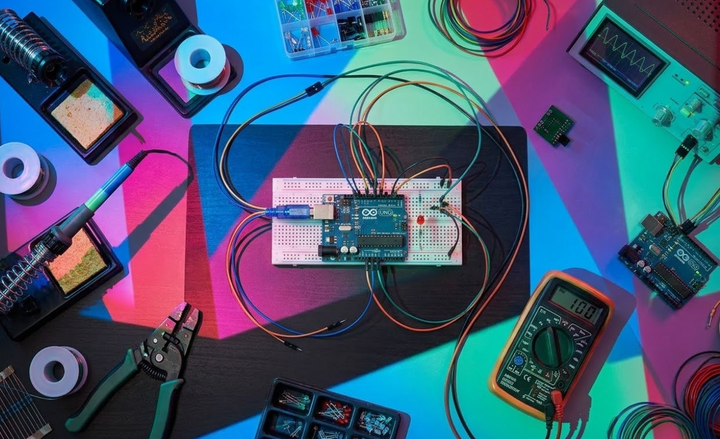
This might seem like an odd inclusion in a robotics guide, but it belongs here precisely because it isn't a robot. The Official Arduino Starter Kit (around £80-110) comes with an Arduino UNO board, a breadboard, a selection of components (LEDs, resistors, sensors, a servo, a DC motor), and a 170-page project book that walks through 15 increasingly complex builds.
None of the projects are a robot in the traditional sense. They're circuits: a light theremin, a colour-mixing lamp, a motorised pinwheel, a basic keyboard. But every one of them teaches a concept, voltage dividers, pulse-width modulation, serial communication, that a teenager will need the moment they try to build something more ambitious. The project book is written for adults and reads like a well-edited textbook, not a children's activity guide.
The reason this matters at thirteen: many teenagers who've used block-based robotics kits (mBot, SPIKE Prime, even Scratch-programmed Arduino) hit a wall when they try to build their own project from scratch. They can make a pre-designed robot follow a line, but they cannot wire a sensor to a board, read its output, and write code to respond to it. The Arduino Starter Kit fills that gap. It builds fluency with electronics at a component level, not a kit level.
The honest downside: there is no robot at the end. The projects are educational but not showy. A teenager who needs visible, demonstrable results to stay motivated will find this kit dry. It is the robotics equivalent of scales and arpeggios: essential, and utterly unexciting to anyone who just wants to play the song.
For the teenager who keeps starting projects and getting stuck at the wiring stage. Not for the one who needs a walking, rolling, or flying thing to maintain interest.
Raspberry Pi 5 + robot chassis build (the open road)
At thirteen, a Raspberry Pi build stops being a stretch project with heavy parental involvement and becomes something a teenager can genuinely own. A Raspberry Pi 5, a motor HAT or controller board, a chassis kit, some sensors, and a power supply, total cost £100-150, produces a robot with no ceiling. Computer vision with a Pi camera. Voice control. Web-based remote operation. Machine learning inference using pre-trained models. Everything a university robotics lab was doing ten years ago is now possible on a £75 board in a teenager's bedroom.
The first thirty minutes will not involve a robot. They will involve flashing an SD card with Raspberry Pi OS, connecting peripherals, and navigating a Linux terminal. For a child who has only ever used Windows or macOS, this is a significant adjustment. But Linux literacy is, increasingly, the dividing line between a teenager who uses technology and one who understands it.
The honest downside is the absence of structure. There is no tutorial that starts at step one and ends with a finished robot. The teenager must find and combine resources from multiple sources: a chassis assembly video on YouTube, a motor control library on GitHub, a Python tutorial on a blog. That process is how real engineering works, and it is also how projects stall indefinitely when motivation dips.
For the teenager who has already used Arduino, wants to write Python, and has the self-direction to manage an open-ended project. Not for a first robotics experience, and not for a household where the adult cannot offer occasional Linux troubleshooting.
When things go wrong
The dominant failure mode at thirteen is no longer frustration or boredom. It is the half-finished project. The chassis is built, one motor works, the code compiles but doesn't do what they expected, and the whole thing gets pushed to the corner of the desk.
This happens because teenagers at this age are good enough to start hard things and not yet experienced enough to finish them without external structure. The useful response is not to fix the problem for them. It is to help them reduce scope. "Forget the camera for now. Can you make it drive in a square?" A project that drives in a reliable square is a finished project. A project that was supposed to navigate autonomously and sort of drives forward sometimes is not.
The second failure is comparison. A teenager watches a YouTube video of someone's robot performing flawlessly and assumes their own should do the same. They don't see the fifty failed attempts behind the final cut. Worth mentioning explicitly: "That person spent six months on this. You've spent a weekend. Your version is supposed to be worse right now."
The third, specific to the Raspberry Pi path, is the debugging spiral. A Python error leads to a library reinstall, which creates a dependency conflict, which requires a forum search, which suggests a command that breaks something else. An adult who can look at the screen and say "let's start fresh with a clean SD card image" will save hours of compounding confusion.
Verdict
For a thirteen-year-old new to robotics, the ELEGOO Smart Robot Car at £60-70 is the lowest-risk way to find out whether this is a passing interest or a real one. For a teenager with Arduino experience who wants something that makes people stop and look, Petoi Bittle X is the most rewarding build at this level, if you can absorb the £300+ price and the occasional stripped servo. The Arduino Starter Kit for anyone who keeps getting stuck at the electronics stage. Raspberry Pi for the self-directed teenager who wants no ceiling, with the caveat that no ceiling also means no floor.
At every younger age, the advice was to match the kit to the developmental stage. At thirteen, match it to the teenager. Their interests, their tolerance for ambiguity, their willingness to read documentation written for adults. The right kit at this age isn't the most advanced one. It's the one they'll finish.
The kits aimed at children have a guardrail for every mistake. The tools aimed at adults have none. Thirteen is when a teenager steps across that line, and what they build matters less than the fact that they built it without someone holding the screwdriver.
Continues from Robotics for 11-12 Year Olds: The Year They Stop Needing the Instructions