How Robotics Changes Young Children's Brains: Research
Eye-tracking study of 6-8 year olds doing robotics found their visuospatial working memory improved 4% every 2 months, logical reasoning jumped, and processing speed increased. Researchers watched kids' brains literally rewire in real-time.

Researchers already knew that robotics improved children's learning outcomes. What they didn't know was exactly what was happening while it was happening. A team decided to find out by tracking children's eye movements throughout the process and the results were more specific than anyone expected.
What the study did
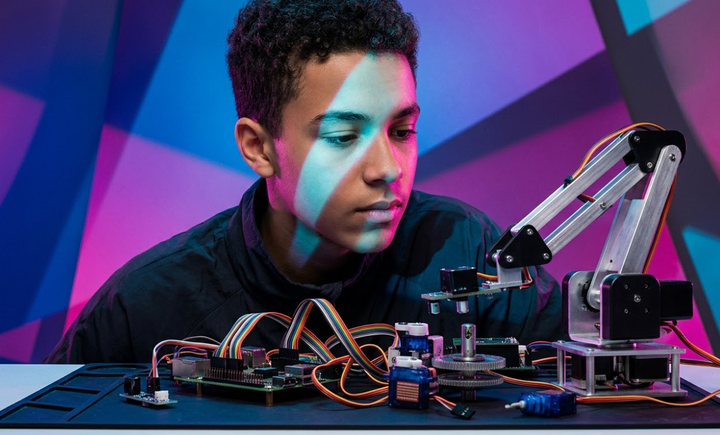
Thirty-one children aged 6–8 were fitted with eye-tracking technology and followed over six months of robotics learning. Instead of just measuring outcomes at the start and end, researchers could observe in real time how children were processing information as they built and coded - where they looked, how long they paused, when they made decisions.
It was the first study to watch children's thinking patterns change as they happened, rather than inferring change from test scores alone.
What they found
Every two months, children's visuospatial working memory improved by around 4%. That's the cognitive skill that lets you mentally rotate objects, hold spatial relationships in mind, and track where things are relative to each other. It's what architects, surgeons, and engineers use without thinking about it.
Logical reasoning scores rose measurably on the Raven's Progressive Matrices - a standard assessment of abstract thinking that has no coding or robotics content. The improvement transferred outside the domain where it was built.
Processing speed increased. By month six, children were making decisions about which components to use and where to place them significantly faster than when they started.
What the eye-tracking actually showed
The data revealed something concrete about how learning was happening.
In the early sessions, children's eyes moved frantically - scanning the whole workspace, returning to the same component multiple times, picking things up and putting them down. The pattern was reactive.
By month six, eye movements had changed. Children looked purposefully at what they needed, made fewer errors, spent more time in apparent thought before acting. The researchers described it as watching children's brains learn to organise visual information efficiently - less searching, more seeing.
Why this age group
The study focused specifically on 6–8 year olds because several factors converge at that age: fine motor development is sufficient for handling small components, abstract thinking is beginning to emerge while still being flexible, and children haven't yet formed fixed beliefs about what they are or aren't capable of.
The window isn't permanent. By the time children have decided they're not good at technology - which often happens earlier than parents expect - the ease of that early learning has passed.
The finding that wasn't in the brief
The study wasn't designed to measure emotional development. Researchers noticed it anyway.
Early in the programme, when something didn't work, children got frustrated, gave up quickly, or blamed the materials. By month six, the same children would systematically debug the problem - try a different approach, ask a specific question, work through it methodically.
The relationship with failure had changed. Not because anyone taught them to respond to failure differently, but because they'd experienced enough of it, in a context where persistence paid off, that their default response had shifted.
The honest costs
Quality robotics kits aren't cheap. There's screen time involved in the coding element. Some children will hit real frustration early and want to stop. Younger children in particular will need adult involvement, especially at the start.
None of this is a reason not to start. But it's worth knowing what the first month might look like before assuming the study's six-month results will appear immediately.
What this means in practice
The skills that improved in this study - spatial reasoning, logical thinking, processing speed, resilience with failure - aren't robotics skills. They're general cognitive tools that transfer to maths, reading, sport, and problem-solving in contexts that have nothing to do with robots.
Children in the programme thought they were building robots. They were, and the robots were the point. But the more durable outcome was what happened to the thinking that built them.
Full study: Journal of Science Education and Technology, March 2023. Free access at PMC: https://pmc.ncbi.nlm.nih.gov/articles/PMC9988604/