The hidden skill that predicts maths success isn't taught in schools. New research says you're probably already building it.
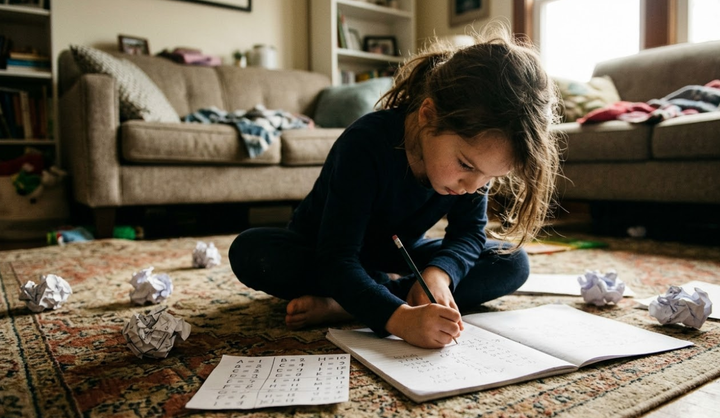
The children who struggled with maths weren't less intelligent. They were missing a spatial foundation the curriculum quietly assumes is already there and nobody notices until the numbers get harder.

A 2025 study set out to understand why some children find maths increasingly difficult as it gets harder and found an answer that had nothing to do with numbers.
The children who struggled weren't less intelligent or less hardworking. They were missing a spatial foundation that most maths instruction quietly assumes is already there.
What the research found
Researchers analysed how visual-spatial skills, the ability to mentally picture, rotate, and manipulate objects, connect to children's mathematical development. The link was consistent and clear: stronger spatial skills predicted better maths performance across the board. Not just geometry. Number sense, arithmetic, word problems. All of it.
The effect was strongest during primary school years, when mathematical foundations are being built. Which means the window most worth paying attention to is right now.
What visual-spatial skill actually is
It's the thinking your child does when they're working out whether a toy fits in a box, predicting which Tetris piece goes where, or reading a map before GPS reroutes them. It doesn't feel like maths. But according to the research, it's doing a lot of the work that makes maths feel either manageable or mysterious.
Specifically, children who can hold images in their minds and mentally rearrange them find it significantly easier to understand place value, what the "hundreds column" actually means visually, to work with fractions before they're just symbols, and to build mental pictures of word problems rather than staring at sentences.
The curriculum assumes this capacity is already there. For many children, it isn't. Nobody notices until the numbers get harder.
The finding that changes what to do about it
Unlike some cognitive abilities that appear relatively fixed, visual-spatial skills respond to practice. The researchers identified activities that genuinely move the needle and none of them feel like maths work.
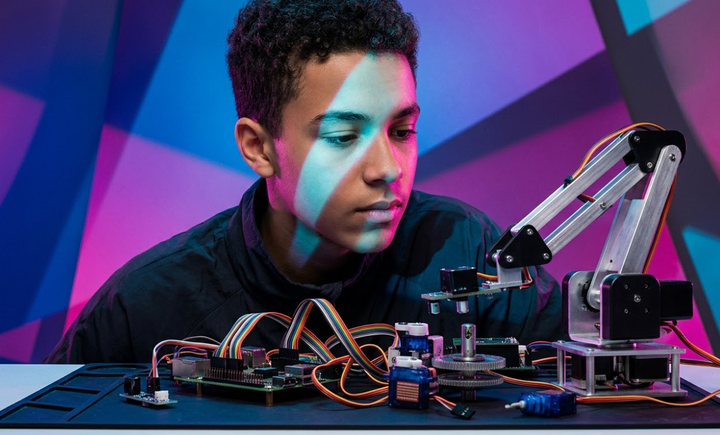
Construction toys, puzzles, origami, building from a picture rather than step-by-step instructions. The common thread is mental prediction: what happens to this corner if I fold here? Does this piece fit before I place it? Can I picture the finished thing before it exists?
Block play matters particularly for under-8s. Research consistently shows that unstructured block play in early childhood, not a programme, not an app, just blocks, predicts stronger spatial skills years later.
Navigation without GPS is underrated. Give children the map. Let them work out which way to turn. Getting it wrong and correcting is the point.
What this doesn't mean
This isn't a story about a maths shortcut or an activity that boosts test scores. The research is about foundations, the underlying mental machinery that makes mathematical ideas easier to grasp when they arrive.
A child who has spent years fitting shapes together, building things, doing puzzles, and reading maps doesn't necessarily know more maths. They just find it less mysterious. The symbols connect to something real.
If your child is 7 and struggling with number sense, the answer might not be more number practice. It might be more puzzles.
A practical starting point
You don't need a programme. Pick one and do it regularly: jigsaw puzzles harder than comfortable, LEGO or magnetic tiles without the instructions, simple origami, building something from a picture, or board games that involve spatial planning.
None of these feel like maths practice. That's rather the point.
Full study: Learning and Instruction, ScienceDirect (2025): https://www.sciencedirect.com/science/article/pii/S0959475225001707