The Night We Met the Hunter
Ages 8-12. Nell went outside during a power cut and the sky filled with stars. Her dad pointed out Orion. She learned that the hunter's shoulder is a dying red giant, his foot burns 120,000 times brighter than the Sun, and the whole constellation only looks like a hunter from where she stood.
It started with a power cut.
The whole street went dark. No lamps, no screens, no fridge humming in the kitchen. Nell stood at the back door in her coat and slippers, annoyed, because she'd been halfway through a level on her tablet and now the tablet was dead.
"Come outside," her dad said. He was already in the garden, head tilted back.
"It's freezing."
"I know. Come outside anyway."
She went. And then she looked up.
The sky had changed. Without the streetlights, without the glow from the estate, the darkness had thickened, and inside the darkness were more stars than Nell had ever seen. Not a handful. Not a scattering. Hundreds.
"Where did they all come from?" she whispered.
"They were always there," her dad said. "The lights just drown them out."
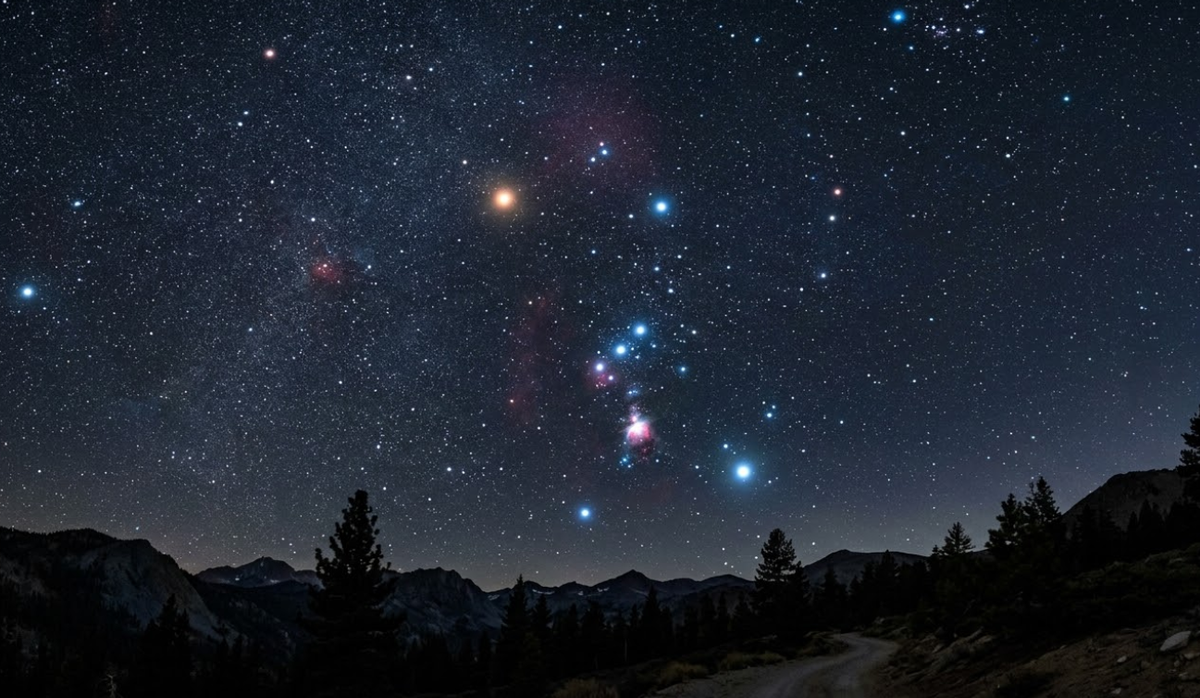
He pointed to a shape low in the south. Three bright stars in a short, straight line, like someone had pressed three thumbtacks into the sky with a ruler.
"See those three? That's a belt."
"A belt?"
"Orion's Belt. He's a hunter. The ancient Greeks thought those stars made the shape of a giant man with a sword and a club, standing in the sky."
Nell squinted. "I don't see a man."
"Look wider. Above the belt, to the left. See that reddish star?"
She found it. It was different from the others. Not white, not sharp. More like a glowing ember, soft at the edges.
"That's his shoulder. It's called Betelgeuse."
Nell laughed. "Like Beetlejuice? The film?"
"Same name, different spelling. It's Arabic. It means something like 'the hand of the hunter.'"
"Cool. So is it big?"
"If you put it where our Sun is, right now, it would swallow Mercury, Venus, Earth, Mars, and Jupiter. The surface of the star would reach past the asteroid belt."
Nell stared at the little red dot. "That tiny thing is bigger than Jupiter?"
"And it's about 650 light-years away. The light you're seeing right now left that star around the year 1375. Before the printing press existed."
She was quiet for a moment, staring at light that had been travelling since before anyone alive had been born.
"Now look at the other side," her dad said. "Bottom right of the belt. The bright blue-white one."
It was easier to find. Fierce and steady, like a chip of ice.
"Rigel. His foot. It's a blue supergiant, even further away. About 860 light-years."
"Further than Betelgeuse?"
"Much further. And it's one of the most luminous stars you can see without a telescope. If the Sun is a candle, Rigel is a searchlight."
Nell looked between the two stars. One red, one blue-white. "They don't even look like they belong together."
"They don't, really. Rigel puts out something like 120,000 times more light than the Sun."
"Why's it blue?"
"Because it's hot. Hotter than the Sun. Around 12,000 degrees on the surface. Hot things glow blue. Cool things glow red."
"So the shoulder one, Betelgeuse, it's cooler?"
"Much cooler. It used to be hot and blue, probably, a long time ago. But it's running out of fuel. It's swelling up and cooling down. One day, maybe tomorrow, maybe in a hundred thousand years, it'll explode."
"Explode?"
"Supernova. When it happens, it'll be bright enough to see during the day. Maybe bright enough to read a book by at night."
Nell looked at the red star again. It was hard to feel afraid of something so quiet.
Her dad crouched next to her and pointed just below the belt.
"One more thing. See those three fainter stars hanging down? That's his sword. The middle one. Look carefully. Does it look a bit fuzzy to you?"
She squinted. "Yeah. It's not sharp like the others."
"That's because it's not a star. It's the Orion Nebula. A cloud of gas and dust, about 1,300 light-years away, and it's making new stars right now. Inside that little smudge, baby stars are being born."
"Right now?"
"Right now. Some of them are only a few hundred thousand years old. Which sounds ancient to us, but for a star, that's basically being a newborn."
Nell pulled her coat tighter. She could see her breath. She looked at the shoulder, the foot, the sword, and thought: one star was dying, one was burning hotter than anything she could imagine, and one wasn't even a star at all. All in the same constellation.
"Dad? The belt stars. Are they actually next to each other up there, or do they just look like they are?"
He smiled. "Good question. They look like neighbours, right? Three stars in a neat line. But Alnitak, the left one, is about 800 light-years away. Alnilam, the middle one, is about 1,300 light-years away. And Mintaka, on the right, is around 900."
"So they're nowhere near each other."
"Not even close. Hundreds of light-years apart. They just happen to line up from where we're standing. If you flew to another star system, the belt would fall apart. The hunter wouldn't look like a hunter any more."
"So constellations are just... an accident? Of where we are?"
"Every single one."
Nell looked at the whole shape. The shoulders. The belt. The feet. The sword. And she thought about how it would crumble from somewhere else. A pattern that only worked from one tiny point in the galaxy. From Earth. From her garden. From exactly where she was standing, on a Tuesday night, in her slippers, during a power cut.
The lights flickered back on. The streetlamp at the end of the road buzzed to life. The stars thinned. Orion was still there, but fainter now, the belt and the two bright corners holding on while everything else washed away.
"I can't see the nebula any more," Nell said.
"It's still there."
She went inside, found a pencil, and opened the back of an old school notebook. She drew three dots for the belt, a red circle for the shoulder, a blue one for the foot. She wrote 800 ly and 1,300 ly and 650 ly next to the stars, and drew arrows showing how far apart they really were. Then she wrote one line underneath:
It only looks like a hunter from here.
She left the notebook open on her desk, went to bed, and wondered what the sky would look like from Rigel.
Try This
Grab a pencil, a blanket, and a clear night. Find Orion's Belt. Three stars in a short, straight line in the southern sky (if you're in the Northern Hemisphere). Once you've found the belt, try to spot the reddish star above it to the left (Betelgeuse) and the bright blue-white star below it to the right (Rigel). Can you tell the difference in colour? If you have binoculars, point them at the middle star of the sword. You might be able to see the fuzzy glow of the Orion Nebula.
Draw what you see. Label the stars. Then look up how far away each one really is, and write the distances next to your drawing.
Talk about this with a grown-up: if constellations only look the way they do from Earth, what would the sky look like from a planet orbiting a completely different star?