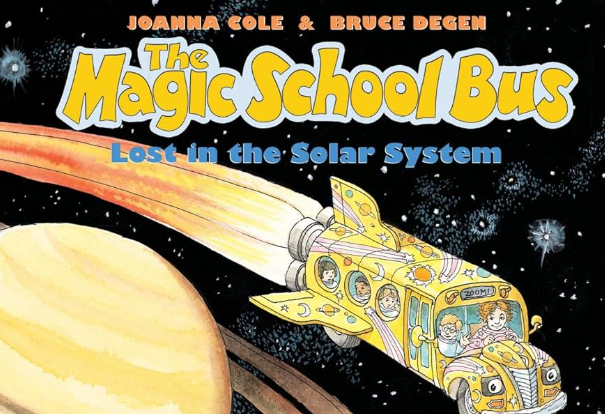
The Magic School Bus Lost in the Solar System by Joanna Cole
It tries to be a story, a science lesson, and a joke delivery system all at once. The surprising thing is how often it pulls off all three. Your kid will find new things on the tenth read. It's not a perfect book. But it might be the one that makes them care about space.
It tries to be a story, a science lesson, and a joke delivery system all at once. The surprising thing is how often it pulls off all three.
Ms. Frizzle takes the class on a field trip to the planetarium, which of course goes sideways, and they end up flying through the actual solar system in the Magic School Bus. Mercury, Venus, Mars, Jupiter, the works. Each stop gets a page or two, and the kids' notebook-style reports line the margins with real facts. The orbit of Jupiter. The surface temperature of Venus. It's textbook material, but it never reads like a textbook because there's always something ridiculous happening in the foreground.
The structure is what makes it work on repeat reads. Your kid will follow the story the first few times. Then they'll start reading the sidebar reports. Then the speech bubbles. Then the tiny jokes tucked into the corners of the illustrations. Bruce Degen packed those pages. Every re-read, a five-year-old finds something new, and they will tell you about it with great urgency.
Reading it aloud is a negotiation, but a good one. The main text flows fine. Nice pace, clear sentences, easy to read at bedtime speed. Your kid will stop you to ask about the sidebar facts, and then you're reading three layers of text on the same page while trying to keep the narrative going. Most parents end up reading the story first and circling back to the reports, which honestly works better anyway. It's longer than it looks. Budget twenty minutes if you're reading everything. Worth it.
The illustrations carry a lot. Degen draws space with genuine scale. When the bus floats past Saturn, the rings stretch across the whole spread, and the bus is this tiny orange speck. Kids notice that. They get quiet for a second. That's the page where the book stops being funny and starts being about something.
One thing to know. The science is dated. This edition still lists nine planets, and the information about some of the outer planets reflects what we knew in the early 1990s. Pluto's demotion alone will spark a conversation you may or may not be ready for at 7:30 on a Tuesday. You can treat it as a teaching moment about how science updates itself, but the book doesn't do that work for you.
Best for ages five to eight. Especially kids who ask a lot of questions and don't mind when a book is busy and packed with stuff. The ones who thrive on it will carry this book around like a reference manual and quiz you on planetary facts at breakfast.
It's not a perfect book. But it might be the book that makes your kid care about space.