Venus: Earth's Twin That Chose a Very Different Life
Venus is almost exactly the same size as Earth, made from the same stuff, born in the same part of space. Scientists once imagined oceans and jungles. What they found was a scorching world of volcanoes and acid rain that never reaches the ground
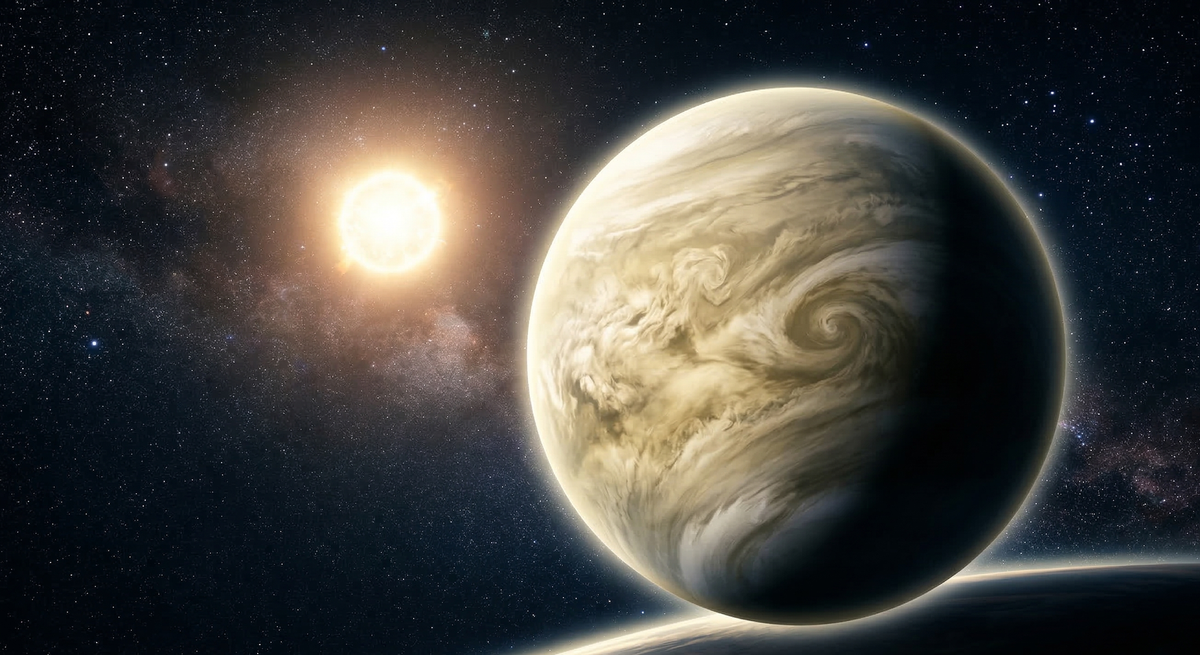
Venus is the planet that should have been us. Nearly the same size as Earth, made from the same stuff, born in the same neighbourhood around the same young Sun. And yet somewhere along the way, its story took a turn so dramatic that today it stands as the most hostile world in the inner solar system. Understanding what went wrong on Venus might be the most important question in planetary science. It is also, for children, one of the most gripping.
The Hottest Planet (and It Shouldn't Be)
Venus is not the closest planet to the Sun. Mercury holds that position. But Venus is far hotter, with surface temperatures that average around 465°C, enough to soften lead into a puddle. The reason is its atmosphere: a suffocating blanket of carbon dioxide more than 90 times thicker than the air we breathe on Earth. Sunlight passes through and reaches the surface, but the heat that rises back up cannot escape. It gets trapped, building and building with nowhere to go. Scientists call this a runaway greenhouse effect. It is the same basic process that warms Earth to a liveable temperature, just taken to a terrifying extreme.
What makes it stranger is that Venus may not have always been this way. Some models suggest that billions of years ago, Venus could have had oceans of liquid water and surface temperatures cool enough to be called pleasant. If that is true, then something tipped it over the edge, and the planet has been burning ever since.
A Day Longer Than a Year
Venus takes 225 Earth days to complete one orbit around the Sun. But it takes 243 Earth days to finish a single rotation on its axis. That means a day on Venus is longer than its year. And as if that were not odd enough, Venus spins backwards. Every other planet in the solar system (with the partial exception of Uranus, which rolls on its side) rotates in the same direction it orbits. Venus does not. If you could stand on its surface and somehow survive, you would see the Sun rise in the west and set in the east.
Nobody is entirely certain why. One theory suggests a massive collision early in its history knocked its spin in the opposite direction. Another proposes that the thick atmosphere and the Sun's gravitational pull gradually slowed and reversed its rotation over billions of years. Either way, Venus is the only planet that has truly turned its back on convention.
Earth's Twin, in Name Only
From a distance, Venus looks like it should be familiar. Its diameter is about 12,104 kilometres compared to Earth's 12,742. Its mass is roughly 82% of ours. Its internal structure, an iron core wrapped in a rocky mantle, mirrors what lies beneath our own feet. For centuries, people assumed it must be a warm, wet world, perhaps covered in swamps and jungles. Science fiction writers set entire civilisations there.
Then we sent spacecraft. In the 1960s and 70s, the Soviet Venera probes descended through the clouds and landed on the surface. They survived for between 23 minutes and about two hours before the heat, the pressure, and the corrosive atmosphere destroyed them. What they sent back was bleak: a dim, orange-tinted landscape of flat volcanic rock under a sky so thick with cloud that the surface receives less sunlight than a heavily overcast day on Earth. The pressure at ground level is equivalent to being nearly a kilometre deep in the ocean.
A World of Volcanoes
Venus has more volcanoes than any other planet in the solar system, with over 1,600 major ones identified and possibly tens of thousands of smaller vents. Its surface is relatively young in geological terms, largely reshaped by volcanic activity within the last few hundred million years.
For a long time, scientists debated whether any of those volcanoes were still active. In 2023, that question was effectively answered. Researchers analysing radar images from NASA's Magellan spacecraft, data collected in the early 1990s, found that a volcanic vent near Maat Mons had changed shape and expanded significantly in less than a year. In 2024, further analysis revealed fresh lava flows at two additional sites. Venus, it turns out, is very much alive beneath its crushing atmosphere. Its volcanic activity may rival Earth's own.
Acid Rain That Never Lands
The clouds of Venus are not made of water. They are made of sulphuric acid. These clouds form a thick, unbroken layer between roughly 45 and 70 kilometres above the surface and reflect so much sunlight that Venus becomes the brightest object in our sky after the Sun and the Moon. On a clear night, it is the first "star" you see, and the last to disappear at dawn.
Within those clouds, winds race at up to 300 kilometres per hour, circling the entire planet in about four Earth days despite the planet itself barely turning. And the sulphuric acid rain that falls from those clouds never reaches the ground. The heat is so intense that the droplets evaporate long before they arrive, rising back up to form clouds again in an endless, closed loop.
Could Something Be Alive Up There?
This is where Venus turns genuinely surprising. The surface is uninhabitable. But at an altitude of around 50 kilometres, conditions are remarkably different. The temperature sits at roughly 60°C, the pressure is close to what we experience at sea level on Earth, and there is enough water vapour and chemical energy to, in theory, sustain microbial life.
In 2020, a team of researchers reported possible traces of phosphine in the upper atmosphere of Venus, a gas that on Earth is associated with biological processes. The finding has since been disputed, and the debate continues. But the question it raised has not gone away. Scientists are now planning missions specifically designed to investigate the Venusian atmosphere for signs of life. It remains one of the most tantalising open questions in the solar system.
The Planet That Warns Us
Venus matters beyond its own story. It is a real, observable example of what happens when a greenhouse effect spirals out of control. It shows us that a planet can start with all the right ingredients for life and end up somewhere unrecognisable. That is not a political statement. It is a fact written across the surface of our nearest neighbour, baked into rock at 465 degrees.
Talking About Venus With Your Kids
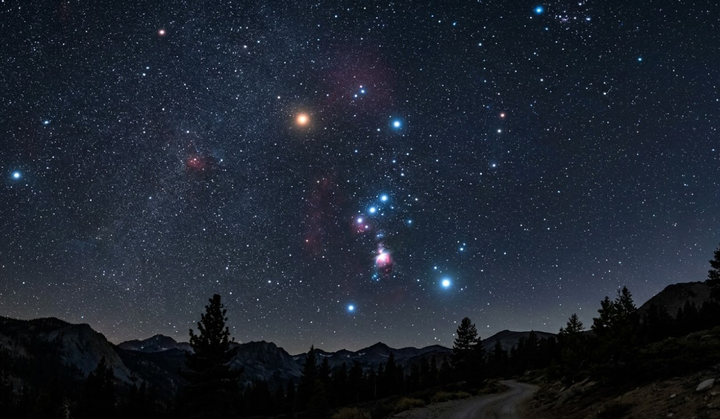
Venus is a wonderful planet to explore with young children because it starts with something they can see. On a clear evening or early morning, step outside and point to the brightest thing in the sky that is not the Moon. That is Venus. Beginning with something real, something they can look at with their own eyes, changes the whole conversation. It is no longer a fact from a book. It is right there.
Before you say a single fact, let them find it. "Can you see that really bright star? That is not actually a star. It is a whole planet." Most children find that genuinely thrilling. If they ask why it is so bright, you can tell them that Venus is wrapped in thick clouds that bounce sunlight back like a mirror.
Use the trick they already know from Mercury. If your child has heard that Mercury is the closest planet to the Sun, ask them which planet they think is the hottest. They will almost certainly say Mercury. When you tell them it is actually Venus, ask them to guess why. You can explain it simply: Venus has a thick blanket of air that traps the heat, like being buried under a heavy duvet on a warm night. Mercury has no blanket at all, so the heat escapes into space. Children remember this because it makes sense to them physically.
Try the twin idea. Tell them that Venus is almost exactly the same size as Earth, made from the same kind of rock, and born in the same part of space. Scientists used to think it might have oceans and jungles. Then ask: "So what do you think it is actually like?" The answer, a scorching world of volcanoes and acid clouds where no human could survive for even a minute, is a genuine shock. That gap between what they expect and what is real is where curiosity lives.
Let the acid rain capture them. Rain on Venus is made of acid, and it never even reaches the ground because the air is so hot that the drops evaporate before they land. For a five-to-eight-year-old, this is the kind of fact that gets repeated at school, at the dinner table, and at bedtime for a week. Let it.
Save the big question. Once they are interested, you can ask: "Do you think anything could live on Venus?" Most children will say no. Then you can tell them that high up in the clouds, where it is cooler and the pressure is gentler, some scientists think tiny, tiny living things might be floating around. Nobody knows for sure. That uncertainty is not a weakness in the conversation. It is the whole point. It shows them that science is not a list of answers. It is a list of questions that keep getting better.
A short conversation that ends with them looking up at Venus on the way home from school is worth more than a long one that loses them halfway through. Let them come back to it. Let them lead.