Saturn: The Planet That Wore Its Crown Late
Saturn's rings may have formed while dinosaurs walked the Earth. The planet is 4.5 billion years old, but its rings are perhaps only 100 million. They are slowly disappearing. We just happen to be alive at the right time to see them
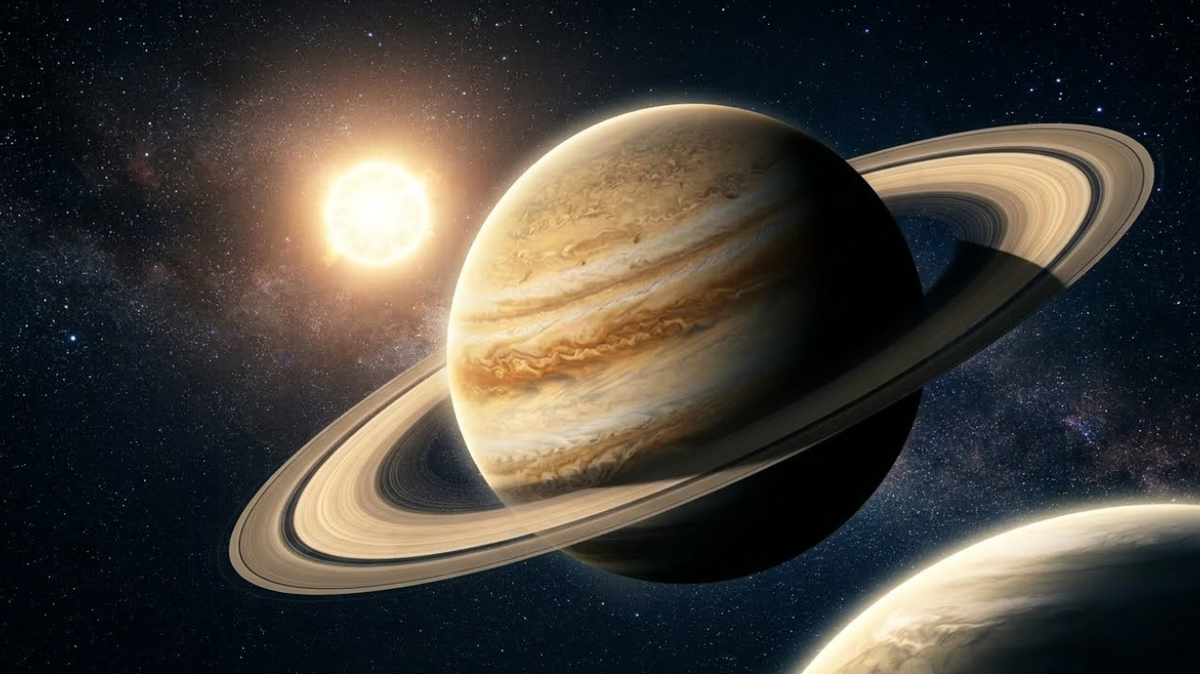
Saturn is the planet that stops people in their tracks. Point a small telescope at it, even a cheap one, and there it is: a pale gold sphere wrapped in a set of rings so clean and so improbable that it looks like someone placed them there deliberately. It is, by most accounts, the most beautiful object in the solar system. And the strangest thing about those rings is that they may not have been there for most of Saturn's life.
A Giant Made of Almost Nothing
Saturn is the second largest planet in the solar system, roughly nine times wider than Earth, with a volume that could swallow more than 760 of our world. Yet it is astonishingly light for its size. Saturn is the only planet in the solar system less dense than water. If you could find an ocean large enough, Saturn would float. That is not a metaphor. The maths works out.
Like Jupiter, Saturn is a gas giant, composed mostly of hydrogen and helium with no solid surface to stand on. Beneath its cloud tops, the atmosphere thickens into liquid, then deeper still into a layer of metallic hydrogen that generates the planet's magnetic field. At its heart, there is thought to be a dense, rocky core roughly 15 to 20 times the mass of Earth. But you would never reach it. The pressures and temperatures would crush anything long before it got close.
Saturn spins fast, completing a full rotation in just over 10 and a half hours. That rapid spin bulges its equator outward, making it the most flattened planet in the solar system. Look at a good photograph and you can see it: Saturn is noticeably wider than it is tall.
The Rings
Saturn's rings are the most complex and extensive of any planet. They stretch more than 280,000 kilometres from the planet, wide enough to fill most of the distance between Earth and the Moon, yet they are remarkably thin. In most places, they are only about 10 metres deep. If you shrank Saturn's ring system to the width of a football pitch, the rings would be thinner than a sheet of paper.
From a distance, they look solid. They are not. The rings are made of billions of individual pieces: chunks of ice, some as small as grains of sand, others as large as houses, a few the size of small mountains. They orbit Saturn independently, each one on its own path, kept in formation by gravity and by the gentle tugging of small moons that shepherd the particles into lanes and gaps.
The most striking gap, the Cassini Division, is about 4,700 kilometres wide and is caused by the gravitational influence of the moon Mimas. It is visible even through a modest telescope, a dark line slicing the bright disc of ice in two.
And here is the part that surprised almost everyone. Data gathered by NASA's Cassini spacecraft during its final orbits in 2017 strongly suggests that Saturn's rings are young, perhaps only 10 to 100 million years old. That means they may have formed while dinosaurs walked the Earth. Saturn is 4.5 billion years old. For most of its existence, it was ringless. Something happened: a comet wandered too close and was torn apart by Saturn's gravity, or a collision destroyed one of its icy moons, scattering debris into orbit. However it occurred, the rings we see today are not a permanent feature. They are losing material constantly, spiralling inward onto the planet. In a few hundred million years, they will be gone.
We are, in cosmic terms, lucky to be here while Saturn is still wearing its crown.
Titan: A World with Weather
Saturn has at least 146 confirmed moons, but one of them is in a category of its own. Titan is the second largest moon in the solar system, bigger than the planet Mercury, and the only moon anywhere with a thick, substantial atmosphere. That atmosphere is mostly nitrogen, similar to early Earth's, and it is so dense that the surface pressure on Titan is about 50% higher than what we feel at sea level.
Titan has weather. It has clouds, wind, and rain. It has rivers, lakes, and seas. But none of them contain water. On Titan, where the surface temperature sits at around minus 179°C, the liquid that fills the lakes and falls as rain is methane and ethane. Titan is the only world other than Earth where liquid currently flows on the surface in a stable cycle. That alone makes it extraordinary.
Beneath its icy crust, Titan is also thought to harbour a subsurface ocean of liquid water, much like Europa and Ganymede around Jupiter. And on its surface, complex organic molecules form in the atmosphere and rain down, building up a chemistry that some scientists believe resembles the conditions on Earth before life began.
NASA's Dragonfly mission, a drone-like quadcopter scheduled to launch in 2027, will fly through Titan's thick atmosphere and hop between locations on its surface, studying its chemistry and searching for signs of prebiotic processes. It will be the first time a vehicle has flown on a world in the outer solar system.
Enceladus: The Tiny Moon with an Ocean
Enceladus is only about 500 kilometres across, small enough to fit inside England. But in 2005, Cassini flew through plumes of water vapour and ice particles erupting from cracks near its south pole and found something remarkable: saltwater, organic molecules, and molecular hydrogen, all shooting out into space from a global ocean hidden beneath the moon's icy shell.
The hydrogen is particularly significant. On Earth, hydrogen is produced at hydrothermal vents on the ocean floor, where hot water meets rock. Those vents are some of the most biologically active places on our planet. The presence of hydrogen in Enceladus's plumes suggests similar processes may be at work beneath its surface. It means that Enceladus has liquid water, a source of energy, and organic chemistry. Those are the three basic requirements for life as we know it, all wrapped inside a moon you could drive across in a few hours.
The Hexagon
At Saturn's north pole sits one of the most bizarre features in the solar system: a hexagonal storm. It is a six-sided jet stream, roughly 30,000 kilometres across (wider than Earth), with winds blowing at over 300 kilometres per hour. It was first spotted by Voyager in the early 1980s and was still there, barely changed, when Cassini arrived over two decades later.
Nobody fully understands why it is hexagonal. Atmospheric models suggest that differences in wind speed at various latitudes can produce stable polygon shapes, but the sheer precision and persistence of Saturn's hexagon remains difficult to explain. It sits there, rotating with the planet, looking like something designed rather than formed. Which is, of course, part of what makes it so captivating.
Talking About Saturn With Your Kids
Saturn is the planet that sells itself. You do not need a clever opening. You just need to show them a picture, or better yet, a view through a telescope. The rings do all the work. The conversation starts the moment they see them.
Start with the rings. If you have access to a telescope or a local astronomy group, a glimpse of Saturn through the eyepiece is one of those experiences children do not forget. If not, a good photograph works almost as well. Tell them the rings are made of billions of pieces of ice, some as small as a grain of sand, some as big as a house. Then tell them the rings are thinner than they can possibly imagine: if you shrank them to the size of a football pitch, they would be thinner than paper.
Use the floating fact. Tell them Saturn is so light that it would float if you could put it in a big enough ocean. This fact never fails. Expect them to want to talk about the ocean for a while. Let them.
Try Titan. Tell them Saturn has a moon where it rains, but instead of water, it rains something like petrol. Where there are rivers and lakes, but they are filled with liquid that would be a gas here on Earth. For a child who loves weird weather or alien landscapes, Titan is endlessly fascinating.
Save Enceladus for the right moment. A tiny moon, small enough to fit inside England, with an ocean hidden under its ice and fountains of water shooting out into space. Scientists think it has everything needed for life. That story has the shape of a mystery, and children feel it.
Show them the hexagon. A storm shaped like a perfect hexagon, bigger than the whole Earth, sitting on top of Saturn. Nobody fully understands why it is that shape. At this age, children love the idea that scientists can look at something and say "we do not know yet." It makes the universe feel open rather than finished.
Know when to stop. Saturn has more than enough material for a dozen conversations. The rings today, Titan next week, Enceladus when they are ready for the life question. And if they ask whether the rings will always be there, you can tell them the truth: they are slowly disappearing. In a few hundred million years, they will be gone. We just happen to be alive at the right time to see them. That is a thought worth sitting with.