The Moon and Human Imagination
Ages 8-12. Look up. Maya squinted at the Moon. "Does it look like a face to you?" Some people saw a rabbit. The Māori saw a woman grabbed by the Moon. Galileo saw craters. 12 astronauts left footprints still up there. Maya grabbed a pencil to draw what she saw.
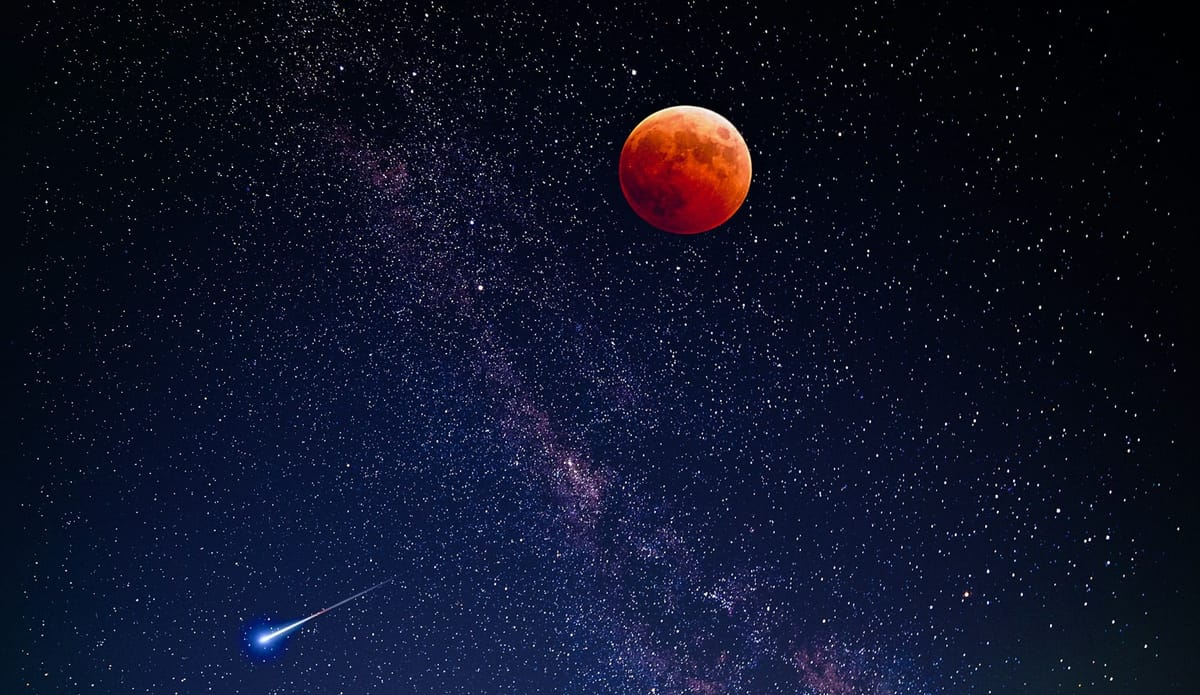
Look up.
There it is. Hanging in the darkness like a lantern someone forgot to turn off.
The Moon has been watching us for a very long time. Longer than cities. Longer than writing. Longer than we've had words to call it by name. And we have been watching it back, wondering, dreaming, telling stories about what it might be.
The Moon was full the night Maya asked.
We were sitting on the back step, socks damp from the grass, and she was squinting up at it the way you squint at someone you’re trying to recognise across a room.
“Does it look like a face to you?”
I looked. It sort of did. Two dark patches for eyes, a smudge of a mouth. Like someone had drawn it in a hurry and never come back to finish.
“Kind of,” I said. “They used to call it the Man in the Moon.”
“Who’s ‘they’?”
“Everyone. For thousands of years. People in Europe, anyway. But here’s the thing: people in other places looked at the same Moon and saw completely different things.”
Maya pulled her knees up to her chin. “Like what?”
“In parts of East Asia, people saw a rabbit. Pounding rice.”
“A rabbit?” She leaned forward. “Where?”
I pointed at the dark patches on the left side. “Tilt your head. The ears are those two bits at the top.”
Maya tilted. Her eyes went wide. “Oh. I can actually see it.”
“The Māori people in New Zealand saw a woman named Rona, trapped up there with a bucket and a tree, because she’d insulted the Moon and it grabbed her.”
“The Moon grabbed her?”
“That’s the story.”
“Harsh.”
She was quiet for a while. I could hear next door’s cat padding across the fence.
“So nobody had telescopes?”
“Not until about 1609. A man called Galileo pointed one at the Moon and saw something nobody expected.”
“What?”
“Craters. Mountains. Huge dark plains. Everyone thought the Moon was smooth and perfect. It wasn’t. It was rough, beaten up, covered in scars.”
Maya looked up again. “I like that better. Smooth would be boring.”
“The dark bits Galileo saw — he called them seas. There’s no water in them. They’re ancient lava flows, cooled solid billions of years ago. But the name stuck.”
“So the face isn’t a face, the rabbit isn’t a rabbit, and the seas aren’t seas.”
“Pretty much.”
“What is it, then? Just rocks?”
I thought about that. “It’s about 384,400 kilometres away. It’s roughly a quarter the width of Earth. It’s got enough gravity to pull our oceans toward it twice a day - that’s what makes the tides. And it’s the only place beyond Earth where a human being has actually stood.”
Maya didn’t say anything for a moment.
“Twelve people,” I said. “Twelve people have walked on it. The first was in 1969. And the footprints they left? Still there. No wind to blow them away. No rain. Nothing. Those prints will last millions of years.”
She stared at the Moon like she was trying to see the footprints from here.
“So right now, up there, there are shoe prints from 1969.”
“Right now.”
A cloud slid across and the Moon disappeared for a few seconds. When it came back, Maya was still looking.
“It’s weird,” she said slowly. “Every single person who’s ever been alive has looked up at that same thing. Like, cave people. Cleopatra. Galileo. The astronauts before they went. Everyone.”
I hadn’t thought of it that way. But she was right. Every human who ever tilted their head back on a clear night saw exactly what we were seeing. The same craters. The same dark patches. The same not-quite-face.
They all just saw something different in it.
Maya stood up and brushed off her pyjamas. “I’m going to draw what I see in it. Not a man. Not a rabbit. What I actually see.”
She went inside. I heard a drawer open. Pencils.
The Moon kept hanging there, patient as always, waiting to see what she’d make of it.
For grown-ups. Try this: Next time there’s a full Moon, go outside and really look at it for two minutes. Don’t think about faces or rabbits - just look. What shape do you actually see in those dark patches? Draw it. Then ask someone else in your house to do the same thing. Compare your drawings. Did you see the same thing? Ask a friend at school. Keep a Moon notebook. You’re doing exactly what every civilisation in history has done - looking at the same rock and finding your own story in it.