The Day We Built an Eye Big Enough to See the Beginning
Age 8-12. Lena pressed her finger against the faintest red dot on the screen. "This galaxy. When this light left, did Earth even exist?" "No. Not even close. The Sun hadn't formed yet." She pulled her hand back like the screen was hot

Lena was lying on her stomach on the living room carpet, chin propped on both fists, watching a video on my laptop.
It was a photograph. Orange and red smudges, tiny dots of light, and one long bright streak arcing across the dark. It looked, she said, like someone had spilled a jar of marmalade on a black tablecloth.
“This is a real photo?”
“Real photo.”
“Of what?”
“Galaxies. Thousands of them. Each one of those smudges is an entire galaxy. Billions of stars in each.”
She sat up. “The little red dots too?”
“Especially those. The red ones are the farthest away. Some of them are so far that the light in this photo left them over 13 billion years ago.”
She did the maths faster than I expected.
“The universe is only, like, 13.8 billion years old.”
“Right.”
“So we’re seeing them when the universe was basically a baby.”
“Basically, yes.”
She looked at the photo again. Differently this time. Like the marmalade had turned into something heavy.
“How?”
“How what?”
“How did they take a photo of something 13 billion years ago?”
I pulled up another image. The James Webb Space Telescope. A giant golden honeycomb floating in the dark, 1.5 million kilometres from Earth, past the Moon, past everything, orbiting the Sun in a spot where it’s always shielded from the glare of our star.
“That thing is a mirror,” I said. “Sixteen hexagonal segments fitted together. Each one coated in a layer of gold thinner than a human hair. It’s 6.5 metres across — about the width of our garden shed.”
“That’s not that big.”
“Big enough. It collects light. Ancient light. Light that’s been travelling across space for billions of years and finally lands on that mirror. Then a sensor turns the light into data, and the data gets beamed back to Earth as radio signals.”
“So it’s like a really, really good camera.”
“More like a time machine that works by being patient.”
Lena thought about this. She pressed her finger against one of the faintest red dots on the screen.
“This galaxy. When this light left, did Earth even exist?”
“No. Not even close. The Sun hadn’t formed yet. That light was already eight or nine billion years into its journey before our solar system was born.”
She pulled her hand back like the screen was hot.
The thing that made the Webb telescope work wasn’t just engineering. It was the people before it.
In 1609, Galileo pointed a small brass tube at the sky and saw craters on the Moon. The tube was barely a metre long. It magnified things about 20 times. That was enough to change everything humans thought about space.
After that, telescopes got bigger. People ground larger mirrors by hand. They built observatories on mountaintops to get above the haze. In 1990, they launched the Hubble Space Telescope into orbit around Earth — above the atmosphere, above the weather, above the blur that makes stars twinkle.
Hubble sent back photographs that made grown scientists cry. Pillars of gas where stars were being born. Galaxies colliding in slow motion across millions of years. The deepest image of space ever taken — a tiny patch of sky the size of a grain of sand held at arm’s length, packed with over 10,000 galaxies.
But Hubble couldn’t see far enough. It saw visible light, mostly. The oldest, most distant galaxies had their light stretched by the expansion of the universe into infrared — a kind of light human eyes can’t detect but that you feel as warmth on your skin.
To see the beginning, they needed a telescope that could see in infrared. They needed Webb.
“How long did it take to build?”
“About 25 years. Over a thousand engineers. It had to fold up like origami to fit inside the rocket, then unfold itself in space over two weeks. One stuck hinge and the whole thing would have been a ten-billion-dollar piece of space junk.”
“Were they scared?”
“Terrified.”
“But it worked.”
“It worked.”
Lena scrolled through more Webb images. A dying star wrapped in rings of glowing gas. A cliff of dust five light-years tall where new stars were punching through. Jupiter, seen in infrared, with auroras flickering at its poles.
She stopped on one. A deep field. Thousands of galaxies again, each one impossibly far away, each one full of stars and planets and things nobody has names for yet.
“If someone’s out there,” she said, very quietly, “in one of those galaxies, and they pointed a telescope at us — they wouldn’t see us. They’d see what was here billions of years ago.”
“That’s right.”
“We’d both be looking at each other’s past.”
She said it like it was the strangest thing she’d ever realised. It might have been.
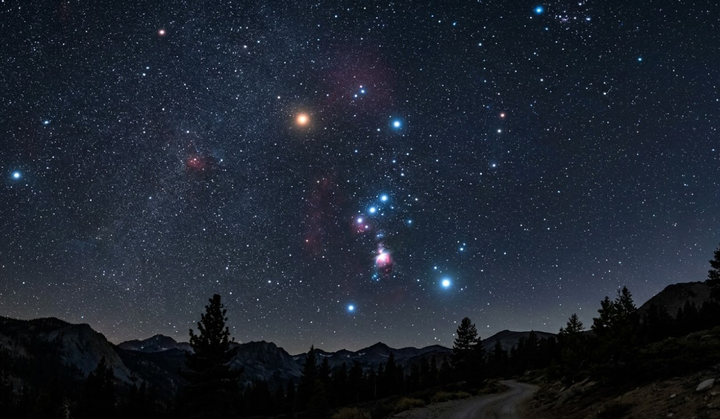
She closed the laptop, stood up, and walked to the window. It was dark outside. Clear sky.
“I want to see it,” she said. “Not pictures. The actual sky. Can we go out?”
We put our shoes on.
Try This: Go to the Webb telescope’s official image gallery online (just search “James Webb Space Telescope images”). Pick one photo. Find out how far away the object is. Then work out how long that light has been travelling — if it’s 5,000 light-years away, that light left its source 5,000 years ago, around the time the pyramids were being built. What was happening on Earth when the light in your photo started its journey? Write it down. You’re reading the universe’s history with nothing but patience and a mirror.