Before They Stop Looking Up: What Works and What Doesn't
Most of us make the same mistake sharing the night sky with kids: we lead with facts. Kids sense immediately that they're being taught, and the wonder drains out. Start with the sky, not the syllabus

The title suggests something more urgent, more about a window closing. Here's the rewrite:
Most kids are born fascinated by the sky. They point at the Moon before they can name it. They gasp at shooting stars without being told to. The curiosity is already there. The challenge isn't sparking it. It's not accidentally putting it out.
And most of us, with the best intentions, do exactly that. We lead with facts. We point at a star and say its name, its distance, its classification, as if the sky were a quiz and the child should be grateful for the answers. Kids, who have excellent instincts for this sort of thing, sense immediately that they're being taught. The wonder drains out before it ever had a chance.
The good news: it doesn't take much to get it right. Mostly, it means getting out of the way.
Start with the sky, not the syllabus
The best opening move is the simplest one: go outside and look up. No preparation, no star chart, no agenda. Just the sky. If the Moon is out, start there. If Venus is hanging bright near the horizon (it's the one that looks too bright to be a star), point at that. Let the real thing do the work. A child staring at the actual Moon through binoculars for the first time doesn't need you to explain orbital mechanics. Their face will tell you the lesson landed.
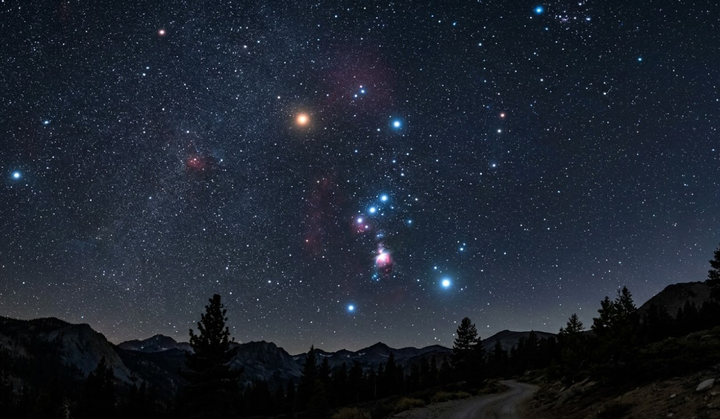
The facts come later, and they come best when a child asks for them. "Why is that one red?" is an invitation. "That's Betelgeuse, a red supergiant approximately 642.5 light-years away" is not an answer to that invitation. But this might be: "That one's called Betelgeuse. It's so enormous that if you dropped it where our Sun is, it would swallow Earth, Mars, and everything out to Jupiter. And it might explode someday. Could be tomorrow. Could be a hundred thousand years from now. Nobody knows." Now you're not teaching. You're telling a story, and stories are what kids remember.
Follow them, not your plan
Kids notice different things than adults do. You're trying to find Saturn, and they're watching an airplane blink across the sky. The temptation is to redirect. Don't. That airplane is their doorway in.
"You spotted the airplane? Nice. See how it blinks? Satellites don't do that. They just glide, smooth and steady, like someone's pulling them on a string. Let's see if we can spot one." Now they're learning to observe, they feel heard, and you haven't mentioned the word "orbit" once.
The same principle works for topics. If your child only wants to talk about black holes, talk about black holes. If Mars is the only planet that matters to them, lean into Mars. You do not need to cover the solar system in order. Curiosity has its own curriculum, and it's better than yours.
Build slowly, keep it short
One of the quietest mistakes is expecting too much from a single session. The sky changes through the year. Constellations drift. Planets wander. A child who can't find Orion tonight might spot it easily by February, simply because they've been looking up regularly.
So make it small and make it routine. "Every clear Tuesday, we check what the Moon looks like" is worth more than one ambitious night where you try to name every constellation. Fifteen minutes of genuine attention beats an hour of cold feet and forced enthusiasm. When they start to fidget, go inside. Leave them wanting another look, not dreading one.
Make it physical
Astronomy for kids works best when it isn't just looking. Track the Moon's shape for a month and draw it each night. Build a scale model of the solar system down your street (the Sun is a basketball, Earth is a blueberry, and by the time you reach Neptune you'll need to walk for a while). Try to spot all five planets visible to the naked eye across a season. The more active it feels, the more it sticks.
Real events help too. A meteor shower next week is a reason to set an alarm and lie on a blanket. A bright full Moon tonight is a reason to step outside after dinner. These moments make space feel immediate, something happening right now, not something sealed inside a textbook.
The questions are the point
"What happens if you fall into the Sun?" "Could a black hole eat Earth?" "Why is space cold if the Sun is so hot?"
These are not silly questions. These are a child doing science: noticing a contradiction, forming a hypothesis, demanding an explanation. Answer them seriously. And when you don't know the answer (you won't, often), say so, then look it up together. That's the most powerful thing you can model: that not knowing something is just the first step toward finding out.
Before they stop looking up
There's a window. It doesn't close suddenly, but it narrows. Screens get more interesting. Schedules fill up. The sky becomes background. The thing you're really protecting isn't knowledge about stars or planets. It's the habit of looking up in the first place.
If your child walks inside after ten minutes thinking "space is cool" rather than "space is confusing," that window stays open a little longer. That's the whole job.
The universe is patient. It'll be up there tomorrow night, and the night after that. All you have to do is keep showing up with them, keep following their curiosity, and let the sky do what it's been doing for billions of years.
It's very good at holding attention, once you give it the chance.